

Every missed call is a missed opportunity. Industry data shows 62% of calls to small businesses go unanswered, and 85% of those callers never call back. For service businesses, that translates to an average of $126,000 in lost revenue every year.
An answering service solves this problem. But with so many options available from live agents, AI receptionists, and hybrid models, the real question isn’t whether to use one. It’s which type actually fits your business.
This guide breaks down the real pros and cons of both human and AI answering services, what they cost beyond the advertised price, and how to figure out which is the right investment for you.
✨ Key Takeaways
- Missed calls cost small businesses an average of $126,000 a year in lost revenue, and 85% of callers who get no answer never call back.
- Human answering services offer empathy, judgment, and a personal touch, but come with higher, less predictable costs.
- AI answering services answer instantly, run 24/7, and cost significantly less, though they still struggle with complex or emotional calls.
- A hybrid model: AI for routine calls, humans for nuance, gives most growing businesses the best balance of cost and customer experience.
- Hidden fees like overages, setup costs, and after-hours surcharges can add 20–60% to your advertised plan price.
What is an answering service?
An answering service is a third-party business that answers, screens, and processes incoming phone calls on your business’s behalf.

Most small businesses can’t realistically answer every call. Staff are on jobs, with other customers, at lunch, or simply off the clock. When a call goes unanswered, most callers don’t wait; they move to the next business. An answering service closes that gap not by making your team available 24/7, but by ensuring every caller reaches someone, not nothing.
Older answering services were simple: someone took messages after hours. Modern services do far more, it can qualify leads, schedule appointments, route calls to the right person, answer FAQs, and sync interactions back to your CRM.
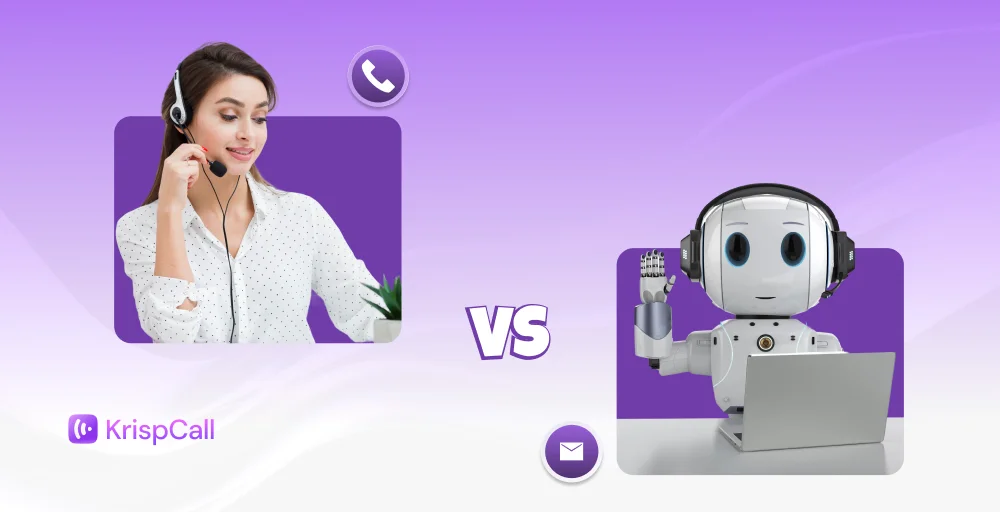
Most answering services fall into three models:
1. Human answering services:
Live agents answer calls, follow scripts, take messages, and route callers based on your instructions. Best for sensitive, relationship-driven industries. These can be outsourced or routed through a VoIP number built into your existing phone system, so agents work directly within the same platform your team uses.
2. AI answering services:
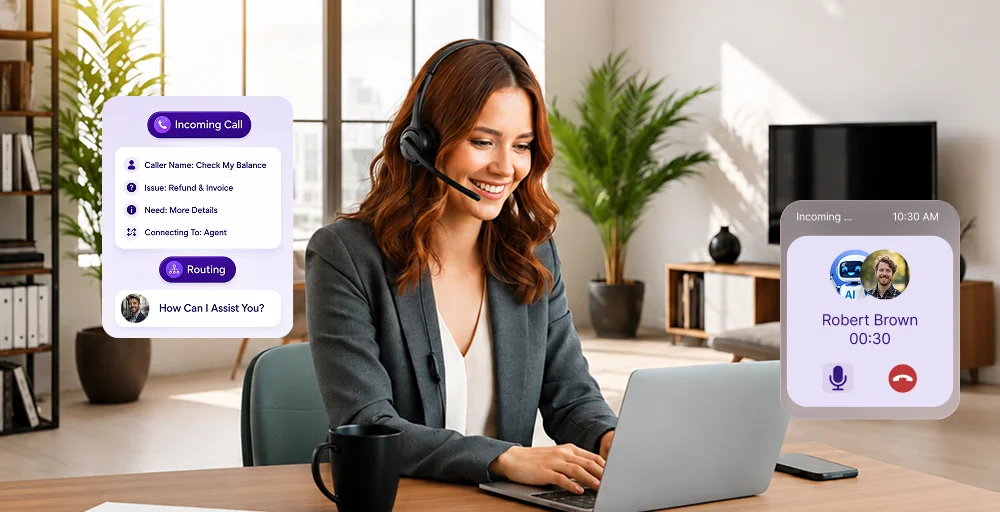
AI-powered agents handle calls automatically, understand caller intent, complete routine tasks, and escalate when needed. Best for high-volume or repetitive call types. When run over VoIP, AI responses, IVR, and call routing all live in one place.
3. Hybrid answering services:
AI handles routine calls first and passes complex or emotional conversations to a live agent. Best for businesses that need both speed and nuance. A VoIP-based setup makes the handoff between AI and human operators seamless, with full call logs and context automatically carried over.
The right model depends on your call volume, industry, budget, and the complexity of your calls. The wrong choice can cost you customers, even when someone does pick up.
Pros and cons of human answering services
While human answering services bring undeniable advantages in empathy, but it also introduce modern operational bottlenecks and unpredictable costs.

Human answering service pros
- Reflects your brand’s tone and identity: Live agents mirror your brand’s voice. Callers feel they reached a real business, not a generic call center.
- Real-time judgment and adaptability: Agents hear tone, hesitation, and urgency. They adjust the conversation accordingly, even going off-script.
- Better suited to sensitive interactions: Healthcare, legal, and counseling calls need patience. Trained agents know how to de-escalate and respond with care and composure.
- Builds trust with hesitant callers: Some callers won’t engage with automation, no matter how good it is. A human voice keeps them on the line and willing to share details.
- Stronger handling of unexpected requests: Unusual questions or multi-part requests don’t fit neatly into scripts. A person can still piece together what the caller needs.
- Personalized follow-up: Agents can reference earlier conversations naturally, recalling names, preferences, or past issues. This builds continuity across multiple calls.
- Upselling and cross-selling opportunities: A skilled agent can spot openings mid-call and suggest relevant services or add-ons, something automated systems rarely do well.
Human answering service cons
- Costs scale with usage and are hard to predict: Live services typically bill per minute or call volume, with monthly costs running $250–$1,000+. Busy periods can push that number up fast.
- Limited ability to scale on demand: A sudden spike in calls can overwhelm a live team. Adding agents takes time, training, and added cost.
- Longer wait times: When agents are busy, callers wait on hold or get sent to voicemail anyway, recreating the exact problem the service was meant to solve.
- Quality can vary by agent: Training, shift, and workload all affect consistency. The experience a caller gets can differ from one call to the next.
- Off-hours coverage is harder to guarantee: Nights, weekends, and holidays are the costliest times to staff. Gaps often appear exactly when missed calls matter most.
- Limited visibility into call performance: Some providers offer minimal dashboards or reporting. Without that data, it’s hard to know how calls are actually being handled.
- Longer onboarding and training time: New agents need time to learn your scripts, tone, and edge cases. Until they’re fully trained, call quality may dip.
Pros and cons of AI answering services
AI answering services bring speed, consistency, and round-the-clock availability, but they also come with limits around empathy and complex conversations.

AI answering service pros
- Instant call answering: AI picks up immediately, with no hold time or queue. Every caller gets a response the moment they call, which matters most when they’re comparing options.
- 24/7 availability: AI doesn’t have shifts or days off. It answers calls on weekends, holidays, and at 3 AM without extra charges or staffing arrangements.
- Predictable pricing: Most AI answering services use flat monthly plans or usage-based pricing. You know what you’re paying regardless of how busy things get, which makes budgeting easier.
- High scalability: Whether you’re getting 10 calls or 10,000, performance doesn’t change. AI scales without the cost or friction of hiring additional agents.
- Smart call routing: AI can identify what a caller needs, collect key information, and route them to the right person or department before a human ever picks up.
- Consistent responses: AI follows approved workflows every time, with no off-script moments or fatigue-related errors. Every caller gets the same quality of interaction.
- CRM and calendar integrations: AI answering services can book appointments, update records, and sync with tools like HubSpot, Salesforce, or Google Calendar automatically, without manual entry.
AI answering service cons
- Limited emotional intelligence: AI struggles with calls that require genuine empathy. A caller dealing with a bereavement or a frustrating problem will often notice the difference from a human agent.
- Accent and speech recognition gaps: AI can misinterpret strong accents, background noise, or unusual phrasing. This can lead to misrouted calls or repeated requests for clarification.
- Over-automation risk: Automating too much can make customers feel like they’re dealing with a wall rather than a business. Tone, pacing, and knowing when to hand off all require careful setup.
- Setup and maintenance: AI works well when it’s configured well. Scripts, FAQs, and routing rules need to be set up carefully and kept up to date as your business evolves.
- Escalation friction: If the path to a human agent isn’t clearly designed, frustrated callers can get trapped in a loop. Poor escalation design is a common complaint about automated systems.
- Struggles with complex requests: If a call doesn’t follow a predictable pattern, AI can get stuck. Multi-part questions or requests that need judgment push the limits of even well-designed workflows.
- Less effective for relationship-driven sales: AI can qualify leads and book calls, but it can’t build the kind of rapport that often closes higher-value or complex deals.
Human vs. AI answering service: Side-by-side comparison
There’s no one-size-fits-all answer. Human services win on nuance and empathy. AI services win on speed, scale, and cost.
Choosing between them isn’t about finding the better technology; It’s about matching the right tool to your specific business operations, customer base, and budget. For most growing businesses, the practical question is where each one performs best, and how to combine them.
| Feature | Human Answering Service | AI Answering Service |
| Availability | Business hours + overtime costs | 24/7 service, no extra charge |
| Call answer speed | Slower; subject to hold times or staffing shortages | Faster; handles simultaneous calls with ease |
| Monthly cost | High ($250 – $1000+) | Comparatively low ($25 – $300) |
| Scalability | Limited | Unlimited |
| Response consistency | Varies by agent | Always consistent |
| Emotional intelligence | High. Detects anxiety, de-escalates anger, builds trust | Low or moderate. Polite and professional, but lacks authentic empathy |
| Data accuracy | Subject to human error (typos, missed fields, lost messages) | 100% consistent. Logs exact data and summaries to CRM instantly. |
| After-hour surcharges | It’s a common occurrence | It rarely applies |
When to choose a human answering service
A human answering service is the right choice if your business:
- Operates in a high-stakes, high-emotion industry like family law, criminal defense, or mental health, where callers desperately need immediate human empathy.
- Deals with high-ticket enterprise contracts where losing a single corporate lead means losing $50,000+ in potential revenue.
- Requires complex, non-linear problem solving where callers often give chaotic, multi-part stories that require a real person to interpret and diagnose.
- Relies on manual, multi-system workflows such as cross-referencing legacy desktop software while simultaneously digging through a highly customized internal database.
- Handles sensitive or highly regulated data intake where a live agent’s real-time judgment call is legally or operationally required to verify information.
When to choose an AI answering service
An AI service makes more sense if your business:
- Regularly misses calls after hours, during lunch breaks, or when your current staff is busy.
- Gets high volumes of repetitive calls.
- Needs 24/7 customer support coverage to capture late-night and weekend leads.
- Wants consistent, script-accurate call handling and an unwavering professional tone.
- Needs to scale instantly during seasonal peaks, major marketing promotions, or sudden demand spikes.
- Wants detailed call analytics and reporting to automatically track trends, log exact summaries, and understand exactly why customers are calling.
When to use both
A hybrid answering service is the ultimate solution if your business:
- Wants a cost-effective operation solution combined with the emotional intelligence of a real human.
- Receives a high volume of mixed traffic, with routine questions (hours, bookings, tracking) and high-value leads or urgent emergencies.
- Wants to eliminate customer hold times entirely by letting an AI instantly greet callers and gather their details before passing complex cases to a live agent.
- Needs to survive on a low budget, using automation to filter out spam, robocalls, and wrong numbers so you can only pay human rates for high-impact conversations.
- Want 24/7 coverage and AI speed without sacrificing customer experience.
What are the hidden costs of answering services nobody talks about?
The advertised monthly rate is rarely what you actually pay. Hidden fees can add 20–60% to your base plan. Here are the charges most providers don’t lead with.
- Set up an onboarding fee: Many providers charge a one-time fee to configure your account, write call scripts, and set up routing. This can range from $50 to $500.
- Overage charges: Most plans include a set number of minutes or calls per month. Exceed that limit, and you’re charged per minute.
- Per-minute rounding: Many providers also round up to the nearest full minute (meaning if your call lasts 2 minutes 40 seconds, they might round up to 4 minutes).
- Holiday and after-hours surcharges: Live answering services often charge 1.5–2x normal rates for evenings, weekends, and holidays.
- Feature add-ons: Call recording, advanced analytics, CRM integrations, and extra phone numbers are often sold separately.
- Cancellation penalties: Many live answering services require 30–60 days’ notice to cancel, with early termination fees of $100–$500 if you exit before a contract ends.
- Spam and junk call charges: Per-call billing means you pay for every call, including spam. At $5–$8 per call, 10 junk calls a month add $50–$80 for zero value.
Which answering service is right for your business?
No single answering service model is universally superior. So, ultimately, the right answering service comes down to three things: the nature of your calls, your coverage gaps, and your budget.
1. Start with your call types
Are most of your calls routine, such as appointment requests, hours questions, order status, or do they involve sensitive or complex conversations?
If the bulk of your calls follow predictable patterns, AI handles them well and saves you significantly. If calls require real judgment or emotional sensitivity, human agents are worth the higher cost.
2. Identify your coverage gaps
If you’re losing calls after hours, during lunch, or when your team is tied up, that’s where an answering service pays off most directly. AI is the most cost-effective way to close 24/7 gaps without adding to payroll.
3. Match the pricing model to your volume
Per-minute billing works for very low or unpredictable volumes. Flat monthly plans make more financial sense once you’re handling 50+ calls per month. AI flat-rate plans almost always outperform per-minute live services at any meaningful call volume.
4. Customer experience expectations
A professional services firm where relationships drive revenue may need the warmth of a live agent. A high-volume service business fielding routine calls around the clock is well served by AI.
5. CRM integrations
A professional business phone answering service should handle calls through smart routing, connecting callers to the right team member. It should also log every interaction directly to your CRM, so no lead goes cold, and no call goes untracked.
Answering service ROI: Does it actually pay for itself?
For most businesses, yes. But the math depends on your industry and average deal size.
Research shows small businesses lose an average of $126,000 per year to missed calls. Each unanswered call costs between $100 and $1,200 in direct revenue, depending on the industry. Home service businesses miss around 27% of inbound calls, with each missed call costing roughly $1,200 in lost work.
The ROI calculation is straightforward:
- AI answering service cost: $25–$300/month
- Live answering service cost: $250–$1,000+/month
- One recovered lead value: Depends on your average deal size
For a home services contractor with an average job of $500, recovering just one extra call per month covers an AI service’s entire cost. For a legal firm or medical practice, the math is even more favorable; a single retained client can pay for months of service.
Companies using AI answering services report an average return of $3.50 for every $1 invested, with top performers seeing up to 8x ROI as the system accumulates data and improves over time.
The bigger risk here isn’t paying for an answering service. It’s continuing to lose callers who never come back.
Answering service industry benchmarks: What good looks like in 2026
If you’re evaluating providers or measuring your current setup, these benchmarks reflect what high-performing answering services deliver:
| Metric | Industry benchmark |
| Call answer speed (AI) | Under 5 seconds |
| Call answer speed (live) | Under 30 seconds |
| First-call resolution rate | 85–95% (AI for routine calls) |
| After-hours call coverage | 100% (AI); 70–85% (live, depends on provider) |
| Caller satisfaction (AI) | 78–85% positive |
| AI vs. human cost differential | AI is 70–90% cheaper than live services |
KrispCall: A smarter solution for small businesses to answer calls
Choosing the right answering service comes down to one thing: making sure no call that matters goes unanswered. Whether you need the empathy of a live agent, the speed of AI, or a combination of both, the right setup should fit how your business actually works rather than forcing you to work around its limitations.
KrispCall is built with that in mind. It brings inbound call management, virtual receptionist, smart IVR, AI-powered call routing, and automatic CRM logging into a single platform, so your team spends less time managing calls and more time closing them.
With virtual numbers in 100+ countries, 24/7 availability, and integrations with 100+ CRM tools, KrispCall gives small businesses the kind of coverage once reserved for enterprise teams.
There’s no complex hardware, no lengthy onboarding, and no per-minute billing surprises. Plans start at $12 user per month, with every core feature included from day one.
If missed calls are costing your business more than you realize, KrispCall is worth a closer look.