


There’s always that moment when an important call comes through, and you’re not ready. Maybe you’re grabbing a coffee, stepping away from your desk, or tied up in another task. It’s frustrating, but missing a call isn’t the end of the world. A quick response or a polite follow-up can save the day and keep everything on track.
However, missing a call can still lead to misunderstandings, lost opportunities, or a lack of attention to customers. A thoughtful and professional response helps maintain relationships, keep opportunities open, and strengthen your credibility.
This guide offers over 20 practical ways to say“Sorry, I missed your call” in a professional manner for various situations.
✨ Key Takeaways
- Apologizing for a missed call builds trust, shows professionalism, and indicates that you value the customer’s time and needs.
- A good apology message should recognize the missed call, convey sincerity, and suggest a clear next step.
- Offering alternative communication methods, such as text or email, helps with follow-up when a call isn’t possible.
- When you apologize, avoid making excuses, saying sorry too much, being vague, getting defensive, or ignoring the missed call.
Why is it important to apologize to customers after missing a call?
Apologizing isn’t just saying “sorry.” It’s a way to reset the conversation and assure the customer that their needs will be met quickly. It’s important to apologize to customers after missing a call to keep a good relationship with them.

This shows that you value them, regret the missed contact, and want to open a dialogue. Handling missed calls with a professional apology is crucial for keeping trust, managing expectations, and maintaining a positive brand image.
Key elements of a professional missed call apology
In business, a missed call is not just silence; it means missing an opportunity. So when apologizing for a missed call, your reply/response should include the following:
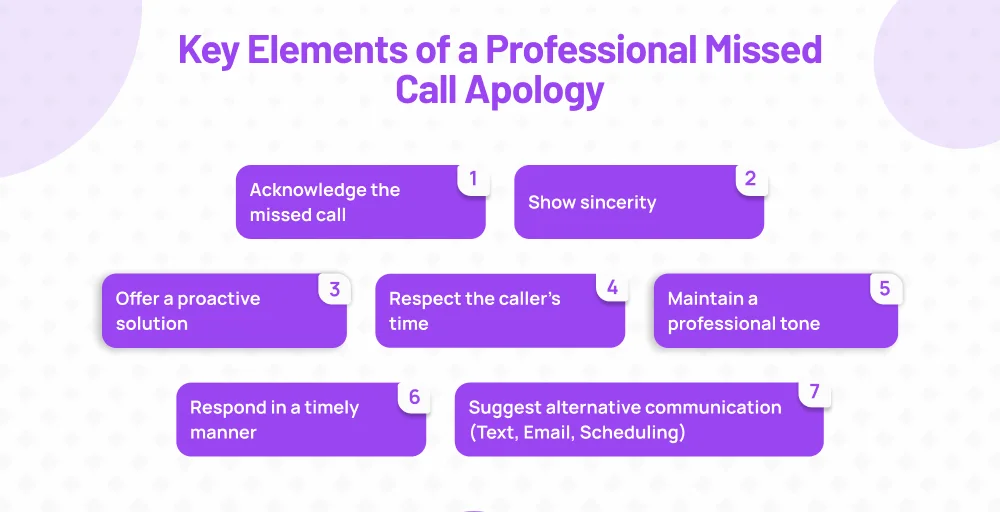
1. Acknowledge the missed call
Acknowledgement is the key to starting a conversation after a missed call. Most of your missing call are probably unintentional, which leads to mishaps. However, acknowledging them shows accountability and empathy, creating a new way to reciprocate a missed call.
2. Show sincerity
To maintain professionalism, showing sincerity and honesty is important. If you have acknowledged your fault for missing a call, then you must be able to show how sincere you are about answering their call.
Even if the missed call isn’t urgent, responding thoughtfully shows respect for the other person’s time. It correlates with making them feel valued and can help rebuild trust.
3. Offer a proactive solution
A proactive approach means recognizing the importance of following up, reaching out again, and setting a good time for a callback. When dealing with potential leads, waiting even 30 minutes to respond instead of replying immediately could result in losing the opportunity.
In summary, being proactive is essential. If you feel nervous about making callbacks, you can still send a short, professional text that works.
4. Respect the caller’s time
Respecting the caller’s time goes hand in hand with professionalism. Demonstrating empathy and acknowledging their time not only boosts credibility but also strengthens customer satisfaction. Instead of remaining silent, always respond politely to let the caller know you appreciate their effort in reaching out.
Young professionals often struggle to balance their priorities. While it’s important to recognize your prospect’s efforts, you also need to consider your own schedule and resources.
5. Maintain a professional tone
In any apology, the tone plays an important role than you’ve ever imagined. Keep your tone light to convey both empathy and professionalism. Like using flattering texts or follow-up calls won’t work in a professional environment. Be concise and consistent when explaining the reason for missing the call.
Emphasize recognizing the circumstances and proposing a solution with understanding. This will appear credible and strengthen your connection with the other party.
6. Respond in a timely manner
It’s common to miss calls, and they don’t necessarily indicate a critical issue. However, the important part is to handle the situation proactively. A prompt response can significantly impact the outcome.
If a call is missed during business hours, it is advisable to give a timely response immediately. For calls missed after business hours, sending a brief explanation and, empathetic text can be a suitable alternative to maintain communication.
7. Suggest alternative communication (Text, Email, Scheduling)
Sometimes returning calls isn’t possible or practical. Especially when on vacation, you may receive important calls but find yourself in a situation where calling back isn’t feasible.
In those instances, it can be difficult to keep up with the conversation, but using alternative ways of communication, such as emails, text messaging apps, or scheduling a callback, can help ensure you stay connected and responsive.
20+ Professional ways to say “sorry I missed your call”
If you’re away from your workplace or out for the day, these templates can help you reply to a missed call via text or provide scripts for a follow-up phone call.
Remember, these provided templates are especially used during business hours and after business hours, so you can select the one that best suits your circumstances.
1. When the caller is a VIP client
If you missed an incoming call from a VIP client, then the apology should be prompt, professional, sincere, and proactive. Your tone should be formal and respectful, clearly outlining your next steps and demonstrating that you value their business.
Option 1:
“Hi [Your Name], I sincerely apologize for missing your call. [explain]. I understand this may be time-sensitive, so I’m available to speak at your earliest convenience. Please let me know the best time for you.”
Option 2:
“Hi [Name], I’m sorry I saw your missed call. I’m available to reconnect today at your convenience. If you prefer, feel free to text or email the best window, and I’ll accommodate it.”
2. When you missed a potential opportunity
Missing a call means losing valuable opportunities for your business. Take immediate action to create a new opportunity and secure your success. Here are the two templates that you can use;
Option 1:
“Hi [Name], I’m sorry for not picking up your call. I’d really appreciate the opportunity to reconnect. Please let me know a time that works best for you.”
Option 2:
“Hello [Name], my apologies for missing your call. I’d love the chance to follow up, as I don’t want to miss an opportunity to connect with you. What time would be convenient for a quick call?”
3. When the call relates to a project deadline
When apologizing for a missed call related to a project deadline, make sure your message is simple, brief, and shows you are on top of the situation and ready to act.
Option 1:
“Hello [Name], I apologize for missing your call. I know we are approaching the [Project Name] deadline, and I want to ensure we’re on track. I’m calling you back in [X] minutes. Alternatively, please text the urgency, and I’ll prioritize it.”
Option 2:
“Hi [Name], so sorry I missed this. I’m concerned about the [Task/Phase] deadline and would love to reconnect immediately. I’m available now. What’s the best time for a quick follow-up today?”
4. When you miss a call from a job applicant or interviewee
When you miss a call from a job applicant or interviewee, your apology must be polite, professional, and immediately offer a clear path forward. You need to reassure them that the missed call does not reflect poorly on their application.
Option 1:
“Dear [Applicant Name], my sincere apologies for missing your call earlier. I was [briefly explain, e.g., in a back-to-back meeting]. I’m happy to reschedule our call. Are you available [suggest specific time, e.g., tomorrow at 10:00 AM] or please let me know a better time.”
Option 2:
“Hi [Applicant Name], I’m sorry I missed your call. I value your interest in the role. Please feel free to call me back at your convenience, or you can email me with any urgent questions you have.”
5. When you miss a call about an appointment
If you ever missed a call regarding an existing or potential appointment, your apology must be concise, confirm the necessary details, and prioritize scheduling or confirming the meeting immediately.
Option 1:
“Hello [Name], I apologize for missing your call regarding our appointment. I just wanted to confirm our meeting is still set for [Day, Time]. If you called to reschedule, please let me know the new time that works best for you.”
Option 2:
“Hi [Name], sorry for missing your call. Regarding our appointment, I’m available to speak now, or I can call you back in 15 minutes to confirm the details. Is that acceptable?”
6. When you were stepping into an urgent situation
When you miss a call because you were dealing with an urgent situation, the apology needs to be brief, accountable, and assure the caller that you are now focused on their needs. Avoid unnecessary detail about the “urgent situation.”
Option 1:
“Hi [Name], my apologies for missing your call. I was handling an urgent, unexpected matter. I am free now and can give you my full attention. What is the best number to reach you at?”
Option 2:
“Sorry I missed your call, [Name]. I had an urgent situation that needed my immediate attention. I’m back and fully available. Please let me know what you need, and I will prioritize it.”
7. When you miss a call from a team member
When you miss a call from a team member or colleague, the apology can be slightly more casual but must still be professional, respectful of their workflow, and encourage immediate reconnection to maintain project momentum.
Option 1:
“Hey [Team Member’s Name], sorry I missed your call. Everything okay? Text me the quick details if it’s simple, or I can jump on a quick call with you in 10 minutes.”
Option 2:
“Missed your call, [Name]! I’m around. Let me know if it was time-sensitive, or if we can catch up later today at [specific time].”
8. When you’re in a meeting
Acknowledge why you wouldn’t pick up, because it shows respect for the people you’re with and the importance of the meeting’s agenda.
Option 1:
“Hello [Name], I’m currently in a meeting that will run until [Time]. I will return your call immediately after I wrap up. Thank you for your patience.”
Option 2:
“Sorry I missed your call, [Name]. I’m tied up in a meeting at the moment. Can you please text me the main point? I can respond to a text message much faster.”
9. When you want to provide alternative contact options
The goal is to let people know that if they can’t reach you right now, they have other quick and easy ways to get their message to you, offering them flexibility and convenience.
Option 1:
“Hi [Name], I apologize for missing your call. If you need a faster response than a callback, please email me at [Email address] or text me. I monitor both closely.”
Option 2:
“Sorry I missed your call. I’m currently away from my phone, but I’m checking my email frequently. Could you possibly send the details to me via email? Thanks!”
Related 👉: How to Get a Second Phone Number Without a Landline or SIM Card
10. When you want to schedule a callback
Suppose you offer specific times, so the other person can choose when to reconnect. Suggesting specific times to talk helps avoid back-and-forth and speeds up the process.
Option 1:
“Hello [Name], I’m sorry I missed your call. I am free to call you back at [Suggest Time 1] or [Suggest Time 2] today. Please let me know which time works best for you.”
Option 2:
“My apologies for missing your call. I’m currently booking my follow-ups. Would it be convenient for me to call you back around 3:00 PM today?”
11. When you want to include a solution or next step
Suggest clear actions to show you are taking initiative and want to resolve the issue. This is an important part of professional communication. Providing a solution right away shows that you are proactive and focused on solving the problem.
Option 1:
“Hi [Name], apologies for missing your call. Based on our last conversation, I’ve already [mention concrete action, e.g., sent the document you requested]. Can we reconnect to discuss it further at 2 PM?”
Option 2:
“Sorry I missed you, [Name]. I anticipated your call might be about [Topic]. I’ve gone ahead and gathered [resource/information]. Please call me back when you’re available so I can share it with you.”
12. When you need to be extra professional
Utilize respectful language to enhance your communication. This approach is essential for high-stakes calls and voicemail greetings, engaging corporate clients, and conducting official correspondence.
Option 1:
“Dear [Name], please accept my apologies for being unreachable when you called. Your business is highly valued. I am available immediately to discuss your matter, or please advise on the most convenient time for a follow-up call.”
Option 2:
“I sincerely regret missing your call, [Name]. I will ensure I am available for you going forward. I am returning your call at this moment to address your inquiry.”
13. For general missed calls
Keep it polite and straightforward. Ensure the caller knows you are open to reconnecting.
Option 1:
“Hi [Name], I missed your call. Apologies! Please call me back when you have a moment, or text me what you need.”
Option 2:
“Hello [Name], sorry I missed you. I’m free for the rest of the afternoon. What time is best for me to return your call? I hope to connect soon.”
14. When you want to keep it short and simple
Some of the missed calls need a short, brief acknowledgement and a clear invitation to reconnect, without unnecessary details.
Option 1:
“Missed your call. Call back?”
Option 2:
“Apologies. I missed this. When are you free to chat?”‘
15. When you want to be polite
To politely respond to a missed call, you can add a helpful follow-up, such as asking if everything is okay, offering to call back, or asking for a good time to connect.
Option 1:
“Thank you for reaching out, [Name]. I sincerely apologize for missing your call. Please let me know a time that’s convenient for me to call you back today.”
Option 2:
“My sincere apologies for the missed connection, [Name]. I’d appreciate the chance to speak with you. I’m available whenever you are ready.”
16. When you want to emphasize an apology
To emphasize your apology, show your regret. Make it clear that you understand the trouble caused and take responsibility.
Option 1:
“I deeply regret missing your call, [Name]. I understand this may have caused an inconvenience. I am free to call back right now. Please confirm if that works for you.”
Option 2:
“I’m very sorry I missed your call. I regret not being able to pick up. Could you please let me know what this was regarding?”
17. When you want to express regret
Express empathy and sincerity. Convey that it was unfortunate to miss the call and indicate a desire to make amends.
Option 1:
“It’s a shame I missed your call, [Name]. I wanted to connect with you. Please give me a quick call back when you’re free.”
Option 2:
“I’m very sorry I missed your call. I regret not being able to pick up. Could you please let me know what this was regarding?”
18. When you want to add a personal touch
To add a personal touch, include a warm or friendly element, such as asking about their well-being, to establish rapport.
Option 1:
“Hi [Name], I missed your call! Hope you are having a good day. Let me know when a good time is for me to call you back.”
Option 2:
“Sorry I missed you, [Name]! I was thinking of you yesterday. Give me a ring when you are back at your desk. Cheers!”
19. When you want them to text instead of calling
Calling may not be suitable in every situation, or sometimes you may not be available to pick up their calls. So, offer them a quick, convenient alternative, like texting. This will ensure effective communication.
Option 1:
“Hello [Name], apologies, I missed your call. If you’re calling from an unknown number, I’m currently tied up, but I can respond to a text message immediately. Is it possible for you to text me the details?”
Option 2:
“Hi [Name], I’m sorry I missed that. I’m in a location where I can’t talk, but texting works perfectly. What can I help you with?”
Related 👉: Personalized Text Messaging for Business
20. When you were on another call
When returning a call, you can say, “Sorry, I missed your call,” and provide a brief reason, such as “I was on another call,” before addressing next steps or asking how you can help. You should apologize, explain why you missed the call, and offer a specific time to call back or get straight to business.
Option 1:
“Sorry, [Name], I was wrapping up an important call. I am free now. Can I call you back immediately?”
Option 2:
“Apologies for missing your call. I was tied up on the other line. I’ll be off in 5 minutes and will call you right back.”
21. When you were driving or away from your desk
Not every time can everyone be present at the desk. If you are far from your desk or were busy and missed a call, explain the reason for your temporary unavailability. Provide a clear, simple way to reconnect safely.
Option 1:
“Hello [Name], I missed your call. I was driving/away from my desk and saw it too late. I’m back now. What’s the best time to connect?”
Option 2:
“Sorry I missed your call. I’m just stepping back to my desk now. Let me know if you are free for a quick conference call in the next 10 minutes.”
22. When the call came outside business hours
Sometimes customers can call outside business hours. In such scenarios, acknowledge the timing and reassure the caller that you will follow up during business hours. This helps to maintain professionalism while managing expectations.
Option 1:
“Hello [Name], thank you for calling. I apologize that I was unavailable, as I am currently outside of business hours. I will return your call promptly at [Time] on [Day] when the office reopens.”
Option 2:
“I appreciate your call, [Name]. I received your message, but I will be able to follow up properly during our business hours, starting at [Time] tomorrow. If it’s urgent, please email me instead.
How to instantly reply to missed calls?
Every time typing the “sorry” message manually can be time-consuming. But with KrispCall, you can set up auto-replies that provide an instant reply to missed calls.
Auto-replies send automated text messages when you miss a call or message. You can set up an auto-reply to respond to the same caller every 3 hours. This way, you don’t have to worry about sending too many replies to customers. You can also customize your responses for during and after business hours, even if you are not available to chat.
Now, you can instant reply to missed calls using KrispCall:
- Sign in to your KrispCall account.
- Navigate to the ‘Settings’ section and click on it to reach the “My Numbers” option.
- Choose the number you wish to configure for Auto Reply.
- On the Number Setting page, scroll down to locate the “Auto Reply Strategy.”
- In this section, you can input custom messages for both first-time and returning callers.
- You can set distinct or identical messages for each group.
- Save your adjustments, and the auto-reply feature will be activated for missed calls.
What to avoid when apologizing for a missed call?
Missed calls happen in business, but you can minimize them with a VoIP provider. If you missed a call and want to apologize, keep these points in mind:
- Be humble and avoid excuses: While you reply, always be humble and avoid providing detailed explanations for why you couldn’t answer their calls. This shows you value them and their needs.
- Don’t over-apologize: Avoid using too many apologizes or being overly dramatic. Excess apologies can come across as insincere and shift the focus away from addressing their needs.
- Avoid vague responses: Don’t use generic or unclear language that doesn’t address their specific need or the professional context of the call. The caller should know you recognize their importance.
- Don’t ignore the call altogether: Simply call them back without any acknowledgment of the missed connection or apology. It shows a lack of professional courtesy and treats their time as disposable.
- Don’t blame technology: Avoid blaming your phone, network, or VoIP system for missing the call. This makes it sound like you’re not taking responsibility for your communication.
- Don’t be defensive: If the caller is frustrated, don’t react poorly or justify your absence. Being defensive can create more tension and show that you are not focused on the customer.
KrispCall: Turn missed calls into actionable opportunities.
Missing a call doesn’t have to mean missing an opportunity; what matters is how quickly and professionally you follow up. By applying the right apology techniques, responding promptly, and offering clear next steps, you can maintain strong customer relationships and protect your brand’s reputation.
Tools like KrispCall’s auto-reply for missed calls feature offer an efficient way to handle missed connections with professionalism and consistency without adding to your workload.
Keep every conversation alive! Get started with KrispCall and never let a missed call go to waste.