


Tracking agent performance and measuring customer satisfaction are critical to any service-driven business. Yet, many organizations still struggle with gaining accurate insights into these interactions. Without clear visibility, it becomes very difficult for them to identify areas that need improvement or take meaningful action.
That’s where call center monitoring comes in and plays a valuable role. Call center monitoring enables the evaluation of the agent’s performance and identifies opportunities to improve and enhance the customer experience.
In this blog, we will explore the definitions of call monitoring, its benefits and types, as well as best practices for effective call monitoring.
✨ Key Takeaways
- Call center monitoring is a process of listening and evaluating conversations between agents and customers.
- Types of call monitoring are real monitoring, call recording, and speech analytics.
- Defining key metrics, implementing unified call monitoring, enabling real-time monitoring, and evaluating performance metrics are effective ways to enhance call center efficiency.
What is call center monitoring?
Call center monitoring is a technique used to evaluate the interactions between customers and agents. The primary objectives of monitoring are to track the call center performance, ensure service quality, and meet customer expectations.

This process is carried out using contact center software and call quality assurance tools that track key performance metrics, enabling real-time or post-call evaluation.
Supervisors and quality analysts may listen to call recordings, live calls, and analyze performance metrics to provide immediate feedback to call center agents, ensuring that customers receive the best customer service. In addition to manual reviews, modern call monitoring leverages analytics to extract insights from customer sentiment, call duration, resolution time, and more.
Why is call center monitoring important?
Call center monitoring brings numerous benefits to companies. Evaluating interactions between customers and agents helps them to identify the company’s issues and improve customer experience.
1. Improve agent skills
Call center monitoring enables businesses to assess agent performance, pinpoint areas where agents excel, and identify areas where improvement is necessary. These insights enable managers to provide targeted training for call center representatives, thereby enhancing their skills.
2. Enhance customer satisfaction
Regularly monitoring the call center helps identify problems that customers are facing, such as long wait times, unresolved issues, or poor service quality. Resolving these issues promptly enables businesses to deliver fast, smooth, and more helpful customer service, leading to improved customer service quality.
3. Identifying the areas to improve
Monitoring helps identify problems that might otherwise go unnoticed. This could be due to technical issues, such as call drops, confusing procedures, or communication problems, including sounding unnatural or rude.
When you regularly review calls, you get to know where your service is not working smoothly and what changes are needed to fix it
4. Higher call resolution
First call resolutions (FCR) mean solving customers’ issues in the first interaction, ensuring no need for additional calls. These techniques help to save time for both customers and team members, ensuring the call center provides the best services.
By monitoring calls, businesses can train their agents to ask the right questions, use proper tools, and follow the best procedures to resolve issues efficiently.
What are the types of call center monitoring?
There are several types of call monitoring to evaluate the interaction between customers and agents. Some of them are discussed below:
- Active call monitoring: Active or real-time call monitoring allows supervisors to listen to the live call conversation between the customer and agent. They can provide suggestions to agents without the customer being aware.
- Call recording: Conversations between the caller and agent are saved or recorded for future use. The manager can listen to the call recordings to evaluate the agent’s performance, check compliance, or provide training to the agent.
- Speech analysts: Analyze customers’ tones and vocabulary to understand their sentiment and solve their issues.
- Performance tracking: Performance tracking, including first-call resolutions (FCR), average call time (ACT), and customer satisfaction scores (CSAT), is used to evaluate and improve the performance of agents.
- Whisper and barge tracking: In the whisper method, the supervisor can speak directly to the agent during a live call without notifying the customer. While in barge tracking, the supervisor joins calls to talk with customers and the agent.
What key metrics and KPIs should you track for monitoring the call center?
It’s important to track the right call center metrics and KPIs that reflect both agent performance and customer satisfaction to ensure your call center monitoring efforts are practical.
- Customer Satisfaction Score (CSAT): CSAT indicates how satisfied customers are with the company’s service. Customer satisfaction is evaluated on a scale of 0-10, with “good” or “bad” as options.
- Net Promoter Score (NPS): The Net Promoter Score (NPS) measures the loyalty of customers towards a company, encouraging them to recommend services to others.
- First call resolution (FCR): First call resolution ensures that the customer’s issues are resolved during the initial call, so they don’t need to call back later for the same topic.
- Average Handle Time: This metric measures the total duration of a customer interaction, encompassing talk time, hold time, and after-call work. Monitoring AHT helps ensure that agents manage calls efficiently, without rushing through conversations or compromising service quality.
- Average speed for an answer (ASA): Average speed for an answer measures how fast an agent can answer the customer’s call in a queue.
10 best practices for effective call center monitoring
Suppose you want to maximize the value of your call center monitoring efforts. It’s essential to follow proven best practices that promote consistency, accuracy, and continuous improvement across your support team.
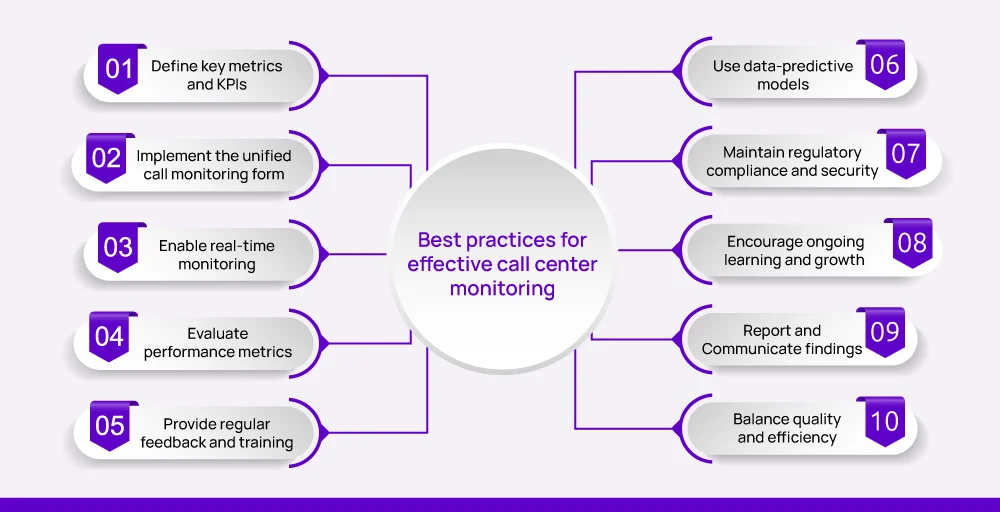
1. Define key metrics and KPIs
First, every call center has its own objectives and goals to achieve. Start by collaborating with managers, supervisors, or team leads to set clear goals and find ways to stay competitive in a dynamic environment, and to address challenges and solve them effectively and smoothly.
After identifying the goal, define key metrics and KPIs to track progress, such as customer satisfaction, first call resolutions, or average hold time.
2. Implement the unified call monitoring form
A simple and clear form is essential to make sure that everyone follows the same pattern. When each person evaluates calls in different ways, it can lead to confusing messages and unfair feedback, creating frustration for both agents and call center managers.
This form should focus on a good customer call, such as the agent’s tone, problem-solving ability, and compliance with company policies. Using the same form makes it easier to spot what’s working and make necessary changes.
3. Enable real-time monitoring
It is essential to have real-time monitoring in order to enhance call quality. This means activating the features such as live recording, call screening, automatic call recording, and real-time screen analytics. These tools help supervisors and managers track the conversation between the caller and the agent.
Train supervisors and managers to set up or customize dashboards to track the right metrics. The supervisor can listen to the live call and identify when it is off track. If an issue occurs, the call center team responds promptly before the problem escalates.
4. Evaluate performance metrics
To understand the performance of the call center, a supervisor or manager needs to review or analyze the customer interactions. This includes the customer satisfaction score (CSAT), first-call resolutions, and average hold time, which help show how the call center is performing.
Consistently evaluating metrics enables supervisors to identify the issues and track progress. Reviewing data regularly helps to set realistic goals and benchmarks, as well as ways to improve performance.
5. Provide regular feedback and training
Call centers require consistent feedback to grow and succeed. The feedback should be positive, encouraging employees to work rather than criticizing them. Instead of waiting for the review performance, create a feedback-friendly environment.
The primary goal is to enhance knowledge, boost confidence, and provide the necessary support, while equipping the agent with the tools needed. Similarly, ongoing training sessions should be held in the form of call center coaching or e-learning modules.
6. Use data-predictive models
Predictive models use historical data to forecast future trends like call volumes, potential customer calls, or to evaluate agent performance. These models help to identify the errors before they arise. It enables managers and supervisors to make smart decisions regarding training sessions and staffing.
7. Maintain regulatory compliance and security
As call center services handle sensitive data, they must comply with laws such as the General Data Protection Regulation (GDPR) or the Payment Card Industry Data Security Standard ( PCI-DSS) to keep customer information safe and secure. Businesses should ensure customer service agents are trained to avoid penalties as well as to earn customers’ trust.
It is essential to implement tools for call recording, encryption, access control, and automated compliance alerts.
8. Encourage ongoing learning and growth
When a business provides a learning culture, agents feel motivated and encouraged to improve their skills and stay focused. Regular training sessions and access to new tools bring enthusiasm to the agents.
A confident and knowledgeable agent provides better service, solves problems promptly, and has positive interactions with customers.
9. Report and communicate findings
Collecting data helps to turn data into meaningful conversations. Monitoring insights should be shared regularly with the team in a way that’s easy to understand and encourages improvement. Highlighting real examples, trends, and progress makes feedback more relatable and actionable.
Open communication creates a culture where agents feel included and supported. When feedback is clear and consistent, it helps everyone stay aligned and work together toward stronger performance.
10. Balance quality and efficiency
A well-run call center strikes the right balance between handling calls quickly and maintaining service quality. Prioritizing speed can lead to rushed conversations and unresolved issues, while focusing too much on quality can slow down call center operations.
The goal is to deliver efficient service without compromising the customer experience. This means coaching agents to work with focus and care, resolving issues promptly while still being thoughtful and professional in every interaction.
Tools you should use for call center monitoring
Choosing the right tools is crucial for successful call center monitoring, as they provide the visibility, analytics, and automation needed to evaluate performance and enhance customer service.
1. Live call transitions
Live call transitions allow supervisors to silently monitor active calls between agents and customers without interrupting the conversation. This feature is especially valuable when handling complex or sensitive interactions, ensuring agents receive support when needed while maintaining a smooth and professional customer experience.
2. Call recording
Call recording captures and stores audio from customer interactions, allowing supervisors and agents to review calls at any time. It provides a non-intrusive way to assess agent productivity, identify areas for improvement, and ensure quality standards are met.
Recorded phone calls also serve as valuable training material for onboarding new team members and delivering targeted feedback.
3. Speech analysts
Speech analytics tools analyze the tone, pace, and sentiment of customer conversations in real-time. By detecting emotions, stress levels, and potential compliance issues, these tools offer valuable insights into both customer experience and agent behavior.
This helps organizations identify trends, improve service quality, and make more informed decisions.
4. Coaching and evaluation tools
Contact center software typically includes tools for coaching and evaluation, such as training modules, feedback forms, in-call checklists, and script suggestions. Administrators can tailor tools to fit team objectives and individual staff requirements.
They work in conjunction with features such as live transcription, AI-driven feedback, and call recordings to streamline the entire coaching and performance review process.
Track, monitor, and optimize your call center performance with KrispCall
Achieving exceptional customer service starts with having the right tools to track and improve every interaction.
KrispCall offers a comprehensive call center monitoring solution that provides complete visibility into agent performance and customer satisfaction. With a real-time call monitoring system, detailed analytics, and easy-to-use recording features, KrispCall empowers supervisors to coach agents effectively and resolve issues faster.Elevate your customer experience and drive measurable results with KrispCall’s powerful live call monitoring tools built for today’s fast-paced business environment.
Frequently Asked Questions
Who is responsible for call center quality assurance?
Those responsible for call center quality assurance include a supervisor, quality analysts, and team leads.