


Many call centers struggle with common issues such as high call volumes, repetitive inquiries, unavailability, and missing leads. For this, businesses keep hiring more and more human agents, which in turn increases the labor cost.
In such scenarios, the use of AI in a call center is beneficial as it helps automate routine tasks and frees up human agents, allowing businesses to rely on AI for these tasks. As a result, customers no longer have to wait for a live agent for every minor issue.
In this blog, let’s find out how you can use AI to reduce the number of call center agents by understanding AI voice agents, their types, and how you can use AI to optimize call center efficiency.
✨ Key Takeaways
- Implement chatbots and AI agents to automate support, build AI-driven self-service, and optimize staffing needs.
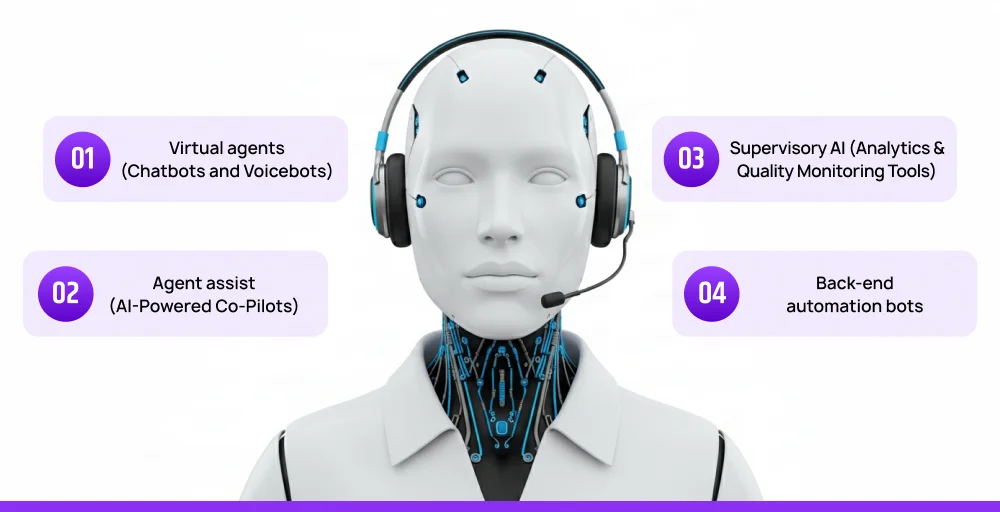
- Call centers typically have four types of AI agents: virtual agents (chatbots/voicebots), agent assist tools, supervisory AI (analytics/quality monitoring), and back-end automation bots.
- Using AI in call centers can significantly help human agents to resolve customer issues instantly and provide personalized service.
What are AI voice agents in call centers?
AI voice agents in a call center are software systems that use advanced technologies like artificial intelligence, natural language processing, and speech recognition to automate customer interactions by understanding and responding to human speech.

Voice AI is capable of understanding and responding to human voices, which makes users feel like they are talking to a live agent with maximum intelligence. Additionally, its ability to learn from each conversation to further customize tone and preferences of content makes it an outstanding must-have feature in the call center industry.
AI voice agents also provide real-time insights into customer call history and automate routine tasks like routing, prediction, and depth data-driven information to make the interaction smooth and personalized. This way, conversational AI can reduce the burden of human agents, allowing them to focus on the crucial tasks that can convert the lead.
What kind of calls can be handled by AI in call centers?
AI in call centers is used to handle multiple calls and assist human agents by automating tasks and providing data-driven insights.
- Routine inquiries: An AI-powered virtual assistant can handle common questions and provide instant answers to customers. This means your team can focus on more complex issues while the AI takes care of high-volume, repetitive queries.
- Automated outbound tasks: The system can place automated follow-up calls or send personalized text messages for tasks like confirming appointments, following up on leads, or sending reminders. This helps maintain a consistent flow of outreach without manual effort.
- Lead qualification and routing: AI can be used to screen new leads by asking key questions and identifying their needs. Based on their responses, the system can automatically tag them and transfer high-priority leads directly to your sales team, ensuring no opportunity is missed.
- Round-the-clock availability: Even after business hours, the AI assistant can handle calls, greet customers, and collect information. This ensures your business is always responsive and provides continuous service, capturing every inquiry regardless of the time.
- Real-time assistance for agents: During a call, tools like AI Copilot can provide live support to your agents, offering relevant information and guiding them toward the best solution. This empowers your team to deliver prompt and accurate service.
- Automated texting for missed calls: If a call is missed, the AI can automatically send a personalized text message to the caller. This feature ensures no inquiry goes unanswered and provides a professional touch even when you’re unavailable.
Types of AI agents in call centers
There are four major types of AI agents in call centers. Let’s take a look at each one of them in brief:
1. Virtual agents (chatbots and voicebots)
Virtual agents are customer-assisting AI tools that interact with customers through text or voice. These systems are trained through customer data to provide personalized service. It uses natural language processing (NLP), speech-to-text, and text-to-speech technologies to understand and respond to customers in need.
Virtual agents handle all the redundant tasks, providing instant support and answers to FAQs, all while automating simple requests and freeing up human agents for more complex issues.
2. Agent assist (AI-powered Co-Pilots)
These tools assist human agents during customer queries and interactions. It listens to the interactions and provides real-time suggestions, relevant information from knowledge bases, and even pre-written response snippets.
This system helps to boost an agent’s productivity, improve accuracy, and ensure consistent messaging while reducing resolution times.
3. Supervisory AI (analytics & quality monitoring tools)
Supervisory AI mainly focuses on analysing large amounts of data to supervise and improve operations. It observes and learn from the customer data, using AI-based analytics to identify patterns, trends, and areas for improvement.
This tool also provides managers with insights into data, ensures compliance, and helps enhance overall call center performance and customer experience.
4. Back-end automation bots
Another use of AI in call centres is backend automation bots that operate behind the scenes to handle internal tasks within the call center environment. It often uses robotic process automation (RPA) to perform structured, redundant tasks, such as data entry, system updates, or record management.
Back-end automation bots increase operational efficiency and reduce manual work, while ensuring seamless execution of internal workflows.
How can I use AI to reduce the number of call center agents?
AI can reduce the number of call center agents by automating routing tasks like solving FAQs, booking appointments, and processing simple service requests.
Here’s a step-by-step approach on how you can use AI in your business to reduce the number of call center agents:
1. Analyze current call center operations
Start by analysing your call center environment, what are the ongoing tasks, and how many resources it requires. Also, identify what percentage of tasks can be automated using AI and what tasks require full human attention. Make sure you have the whole idea of your call center operation before implementing AI.
Additionally, keep track of your call volumes, peak hours, routine update requirements, troubleshooting help, general information, and agent workload. Finally, calculate what services can be automated using AI chatbots, AI reply, self-service FAQs, or technologies like AI voices for direct interaction with customers.
This way, you can use AI for the simple tasks and only staff human agents as per the need for crucial tasks.
2. Implement AI chatbots for web and app support
Once you have a clear picture of the basic requirements and operational details of your call center workload, start implementing AI. You can use AI chatbots, virtual assistants, and conversational IVR systems to handle routing queries, provide self-service options, and offer instant responses.
Since AI is available 24/7, it provides customer support even after business hours. But make sure to train your AI bots about the complete information of your product and use in-depth information in its knowledge base.
After everything is set up, your AI agents and chatbots can significantly cut down the number of calls that reach live agents. For example, if you need to reply with well-crafted messages, you don’t need to hire a skillful agent instead you can use AI assist feature.
3. Deploy AI voice assistants for phone calls
Leverage a multi-level IVR system to ensure customers are greeted with the custom greeting messages and then routed to the right agent after their query is addressed. For simple tasks, let AI chatbots handle the queries and offer self-service options, and only connect to live human agents when necessary or requested.
This means your agents only deal with cases that really need human attention; otherwise, AI voice assistants act as the first line of support when customers call. This reduces call wait times and lowers the number of agents needed to handle basic inquiries.
4. Automate ticketing and routing with AI
AI can automatically create support tickets, assign them to the right team, and prioritize urgent cases. It can also route phone calls to the correct department without human involvement. This saves time and reduces the number of agents needed for basic administrative work.
Instead of relying on agents to log and transfer cases, AI can automatically categorize tickets based on issue type, assign them to the correct department or priority level, and track resolution status.
This way, you can reduce bottlenecks and manual effort. As a result, fewer agents are needed to manage customer requests.
5. Implement AI-assisted tools for human agents
The right tools assist agents in resolving customer inquiries instantly and efficiently. Providing AI-assisted features like voicemail transcription, real-time analytics, and sentiment analysis helps agents respond faster and handle more calls in less time.
This way, even the limited number of human agents can handle multiple calls. The AI tools can make it easier for agents to handle critical customer queries, giving instant access to customers’ past interactions.
These enhancements help agents handle more interactions in less time, effectively reducing the total number of staff required.
6. Build AI-driven self-service channels
Most customers now prefer resolving their simple issues by themselves instead of contacting call center agents.
Providing a self-service option helps them to solve their problems on their own. By analyzing the common customer queries, companies can utilize chatbots to give answers to these basic inquiries. This includes checking order status, shipment tracking, order confirmation, and more.
Offering self-service options means lowering inbound calls. That means fewer agents are required to resolve the complex queries that AI can’t handle.
7. Use predictive analytics for staffing optimization
Call centers can utilize predictive analytics and live call monitoring tools to figure out the staffing requirements. Analyzing past call data, these tools predict the number of agents required for a certain period of time.
This ensures accurate staff management; when needed, more agents can be hired, and during low-demand periods, resources can be optimized to avoid overstaffing.
8. Monitor, measure, and continuously improve AI performance
After you place everything in place with the automated AI tools and fewer live agents (only as per the requirement), you now have to monitor the working methods continuously. Make sure every AI tool and functionality is working properly, and check each feature one by one before you go live with AI automated features.
Track the number of problems solved without agent help, how customers feel about AI interactions, and how much time and cost you are saving. Use this feedback to improve your AI over time.
Also monitor ongoing processes using necessary KPIs like customer satisfaction scores (CSAT), average handle time, and first call resolution. This way, instead of adding more agents to manage higher call volumes, you can make AI handle common requests while your team focuses on the complex ones.
Leveraging AI to optimize call center efficiency
AI has transformed the way businesses connect with their customers. In call centers, it improves agent productivity by handling repetitive tasks and providing real-time assistance. Instead of focusing on how to reduce calls in a call center, businesses can leverage automated features like a virtual receptionist to handle basic customers’ needs.
Meaning, basic queries are resolved with AI and only complex ones require human agents, reducing staff requirements.
But for that, you need an advanced AI agent and a reliable provider that offers all the required call features and AI automated tools for the call center environment.