


Customer expectations for phone support have changed. People don’t want to “press 1 for sales” and bounce through menus, they want to say what they need and get help fast. At the same time, support teams are dealing with higher volume, tighter budgets, and more complex issues.
That’s where IVR and IVA come in. Both are designed to automate parts of the customer journey when someone calls your business. But they work very differently, and choosing the wrong one can create more friction than it removes.
In simple terms: IVR is menu-based automation, while IVA is conversation-based automation. IVR guides callers through predetermined options. IVA uses speech and language understanding to interpret what the caller means and respond more naturally.
This difference affects everything: how quickly a customer gets an answer, how many calls get deflected from agents, how much effort it takes to maintain the system, and how well the experience scales as your support needs grow.
In this guide, you’ll learn what IVR and IVA are, how they work, where each one fits best, and how to decide whether you need a traditional IVR, an AI-powered IVA, or a hybrid approach that combines both.
✨ Key Takeaways
- IVA utilizes NLP to understand and respond to customer inquiries in a conversational, human-like manner.
- IVR guides the customer through a menu, allowing them to reach their intended destination.
- IVA is best for providing automated support for voice and chat channels, while IVR simplifies call handling.
What Is IVR (Interactive Voice Response)?
Interactive Voice Response (IVR) is an automated call-handling system that enables businesses to manage inbound phone calls without requiring a live agent for every interaction. It allows callers to navigate menu options, retrieve information, and complete simple transactions, such as checking account balances or making payments, through voice commands or keypad inputs.
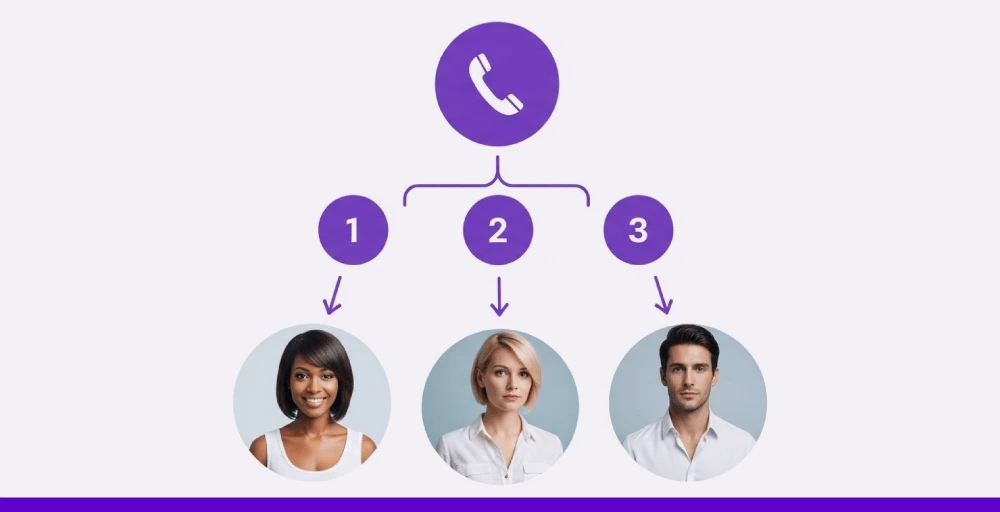
By automating routine inquiries, IVR systems reduce wait times for customers while lowering operational costs for businesses. This makes IVR a foundational technology in modern call center automation.
The technology behind IVR
IVR systems are built on earlier telephony technologies that enabled automated caller interaction. One of the earliest components is Dual-Tone Multi-Frequency (DTMF) signaling, which allows callers to respond to prompts using their telephone keypad. For example, a system may instruct callers to “Press 1 for Sales or 2 for Billing,” and the keypad input directs the call accordingly.
Another essential component is Automatic Call Distribution (ACD). ACD systems intelligently route incoming calls to the appropriate department or agent based on the caller’s selection. This ensures inquiries are handled efficiently and by the right team.
Modern IVR platforms combine DTMF input and ACD routing into a unified system, creating a streamlined call flow that reduces friction and improves operational efficiency.
How IVR enables self-service
Beyond simple keypad navigation, IVR systems increasingly rely on voice recognition technology. Instead of pressing numbers, callers can speak their responses naturally. For example, an IVR prompt might say:
“Please enter or say your account number to proceed with your payment.”
Once the system captures the information, it routes the caller directly to the relevant service portal or completes the transaction automatically. This self-service capability empowers customers to resolve straightforward issues quickly, without agent intervention.
Advanced IVR and natural language processing (NLP)
The most sophisticated IVR systems incorporate Natural Language Processing (NLP). Rather than limiting callers to predefined phrases, NLP-powered IVR can understand full sentences such as:
“I’d like to check my account balance.”
By identifying keywords, intent, and contextual meaning, NLP enhances accuracy and reduces call friction. When trained using real customer queries and common language variations, advanced IVR systems can resolve issues more efficiently and deliver a smoother customer experience.
As a result, businesses benefit from reduced call handling costs, while customers experience faster resolutions and more intuitive interactions.
What is IVA (Intelligent Virtual Agent)?
Intelligent Virtual Agent (IVA) is an AI-powered customer interaction system that enables businesses to automate and manage complex conversations without requiring a live agent for every request.
Unlike traditional Interactive Voice Response (IVR) systems that depend on predefined menus and keypad inputs, IVA uses conversational artificial intelligence to understand natural language, interpret user intent, and respond dynamically across voice and digital channels.

IVA systems are built on technologies such as Natural Language Processing (NLP) and Natural Language Understanding (NLU), which allow them to process full sentences, recognize synonyms, and detect contextual meaning.
By integrating with Customer Relationship Management (CRM) platforms and backend systems, IVA can access real-time customer data to deliver personalized responses.
Features like machine learning enable continuous improvement based on past interactions, while voice biometrics strengthens identity verification and fraud prevention.
Through intent recognition, contextual analysis, and intelligent routing, IVA can handle detailed inquiries, automate routine service tasks, support multilingual communication, generate support tickets, and escalate complex issues to live agents when necessary.
This makes IVA a scalable solution for modern contact centers focused on operational efficiency, reduced handling time, enhanced customer experience, and secure digital interactions.
How IVR and IVA differ in architecture and intelligence
While IVR and IVA both automate customer interactions, they operate on fundamentally different models of intelligence.
IVR systems follow predefined decision trees. Every possible path must be built in advance, and each caller input maps to a fixed routing rule. If the caller’s request falls outside the programmed structure, the system cannot adapt. The interaction is structured, predictable, and rule-driven.
IVA systems, on the other hand, operate on intent recognition models. Instead of matching a keypad selection to a branch, the system analyzes spoken language, detects intent, evaluates context, and dynamically generates a response or action. This allows IVAs to handle varied phrasing, layered requests, and more complex workflows.
The architectural difference is significant:
- IVR = structured automation based on menu logic
- IVA = adaptive automation based on language understanding
This distinction affects scalability, personalization, implementation complexity, and long-term operational efficiency.
What are the main differences between IVR and IVA?
| Criteria | IVR | IVA |
| Technology Used | Uses DTMF, voice recognition, and basic NLP. | Uses conversational AI, advanced NLP, and machine learning. |
| User Input | Accepts keypad entries and simple voice commands. | Processes spoken input and keypad tones using AI. |
| Personalization | Offers limited or no personalization. | Provides tailored responses using customer data. |
| Scalability | Handles high call volumes but adapts slowly to changes. | Scales easily and adapts to new business needs. |
| Customer Experience | Provides a basic, menu-driven experience. | Delivers natural, human-like interactions. |
| Cost | Lower cost and suitable for simple needs. | Higher cost due to advanced AI features. |
At a high level, IVR and IVA both aim to automate customer interactions — but they differ in how they process input, manage workflows, and scale over time.
1. Interaction model
IVR relies on structured menu navigation. Callers must follow predefined options and respond using keypad selections or limited voice commands. The experience is guided and linear.
IVA enables open-ended conversation. Callers can speak naturally, and the system interprets intent using natural language understanding. The interaction feels more dynamic and less constrained.
2. Intelligence layer
IVR operates on rule-based logic. Each input corresponds to a programmed branch in a decision tree. Changes require manual updates to call flows.
IVA operates on AI models. It uses Automatic Speech Recognition (ASR) and Natural Language Processing (NLP) to detect intent and generate responses. Over time, machine learning improves accuracy based on real interactions.
3. Flexibility and personalization
IVR provides limited personalization unless heavily integrated with backend systems. Most experiences are standardized across callers.
IVA can personalize responses using CRM data, past interactions, and contextual signals. It adapts to varied phrasing and layered requests.
4. Implementation complexity
IVR systems are generally simpler to deploy and maintain. They require structured flow design but minimal AI training.
IVA systems require training data, intent modeling, integration layers, and continuous optimization. The initial setup is more complex but supports greater long-term scalability.
5. Business impact
IVR reduces operational load by automating routine inquiries and routing calls efficiently.
IVA goes further by increasing self-service resolution rates, reducing agent escalation, and improving customer satisfaction through conversational automation.
Benefits of IVR
1. Structured Control Over Call Flows
Because IVR operates on predefined decision trees, businesses maintain full control over routing logic and customer paths. This predictability reduces system ambiguity and ensures compliance with internal processes.
2. Operational Efficiency at Scale
IVR efficiently handles high volumes of routine interactions, such as account verification or department routing, without requiring proportional staffing increases.
3. Lower Technical Barrier to Entry
IVR systems require flow configuration rather than AI training. This makes deployment faster and more cost-effective for organizations with straightforward workflows.
4. Reliable Performance for Simple Tasks
For well-defined, repetitive inquiries, rule-based automation is stable and dependable. There is minimal variability in outcomes.
5. Cost Containment
By automating routine inquiries and reducing agent workload, IVR lowers operational expenses while maintaining baseline service quality.
Benefits of IVA
1. Conversational Interaction Model
IVAs allow customers to speak naturally rather than navigate structured menus. This reduces friction and improves perceived service quality.
2. Higher Self-Service Resolution
Because IVA systems interpret intent rather than fixed inputs, they can resolve more complex or layered requests without escalation to a live agent.
3. Adaptive Intelligence
Machine learning enables IVA systems to improve over time. As they process more interactions, intent detection accuracy and response quality increase.
4. Personalization and Context Awareness
By integrating with CRM systems and APIs, IVAs can tailor responses based on user history, preferences, and contextual signals.
5. Long-Term Scalability
Although implementation is more complex, IVA systems scale more effectively for businesses with growing interaction complexity and omnichannel demands.
Can IVA and IVR work together?
Yes, IVR and IVA can work together to improve customer service. Many businesses use IVR for basic call forwarding or routing and then pass more complex requests to an IVA.
IVR handles simple tasks like greeting callers and directing them to the right department. When needed, it transfers the call to an IVA for personalized support and detailed assistance.
The IVA then uses customer data to offer personalized responses and a smoother experience. This seamless hand-off means callers don’t have to repeat information.
Together, they provide 24/7 customer support and reduce the workload on human agents. This combination helps businesses manage high call volumes while keeping customers satisfied.
IVR vs IVA: Should your business make the switch?
While IVA systems use AI and NLP to deliver advanced support, they are not always the best fit for every business. For companies with basic call management needs or tighter budgets, a simple IVR system can be more practical.
KrispCall’s IVR feature offers an easy way to automate calls and forward customers. It allows businesses to create a multi-level menu to guide callers efficiently.
These menu segments incoming calls to reach the right team. Plus, you can customize it to meet your business needs, including language preferences and topic selection.
If your goal is to enhance customer service and improve your first-call resolution rate, KrispCall’s IVR (phone tree) is the ideal choice. Before moving to IVA, consider whether upgrading your IVR setup with KrispCall can better serve your current needs.