


In today’s hyper-competitive market, acquiring new customers is getting more expensive every year, yet many businesses still pour most of their budget into acquisition while watching existing customers quietly churn. The result? Stagnant growth and missed revenue opportunities.
Customer lifecycle management (CLM) changes that equation. It’s the strategic process of guiding prospects and customers through every stage of their relationship with your brand, from first awareness to loyal advocacy, while measuring, optimizing, and personalizing each touchpoint.
Done right, CLM can reduce churn, increase customer lifetime value (CLV), and turn satisfied customers into powerful advocates. Research shows that increasing customer retention by just 5% can boost profits by 25% to 95%, and retaining an existing customer is 5–7 times cheaper than acquiring a new one.
✨ Key Takeaways
- Customer lifecycle management is the process of managing and optimizing customers’ journeys at every stage to provide personalized support.
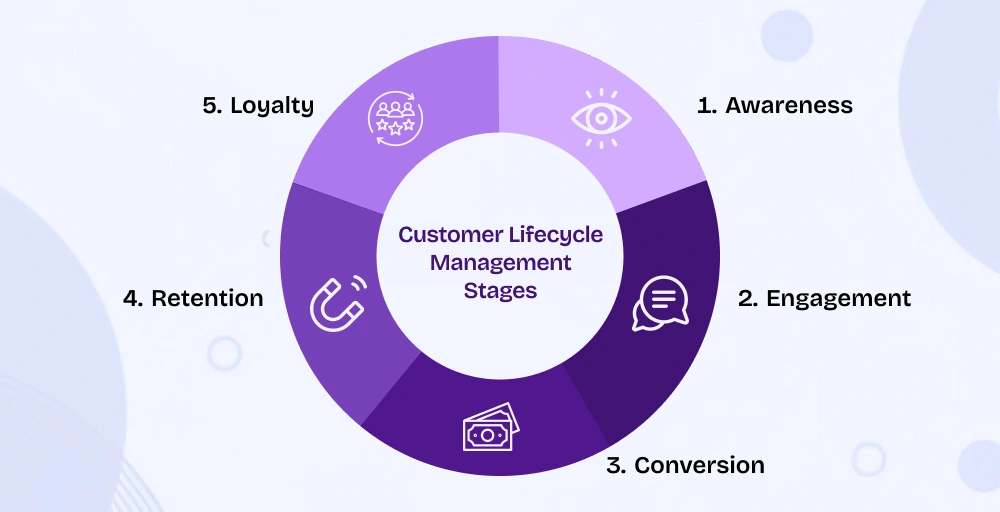
- The major customer lifecycle management stages include awareness, engagement, conversion, retention, and loyalty.
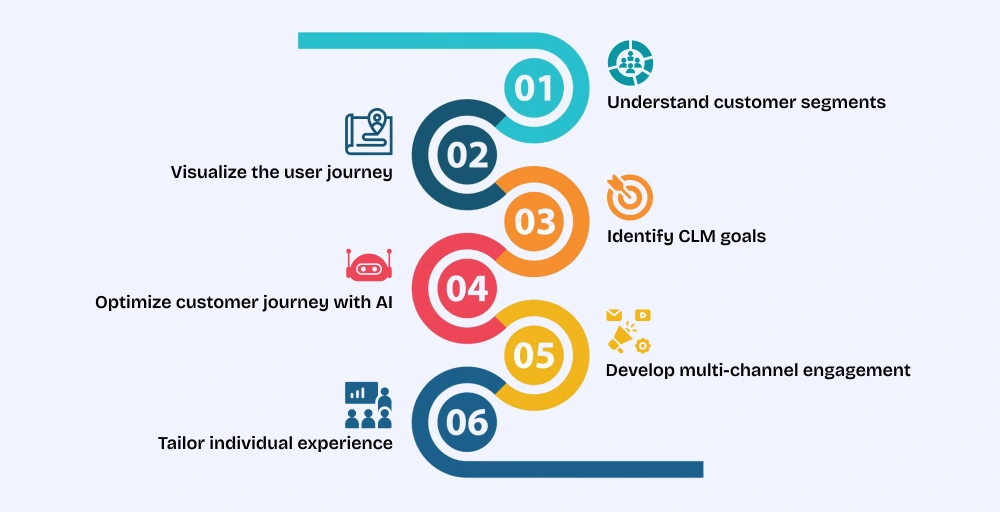
- To manage the customer lifecycle process, you need to understand your customers, visualize and optimize their journey using AI, develop multichannel support, and customize individual experiences.
What is the customer lifecycle?
The customer lifecycle represents the complete journey a person takes with your brand from the moment they first hear about you until they become a long-term advocate (or leave).
Unlike a one-time transaction, it’s an ongoing relationship that evolves over months or years. Understanding this lifecycle helps you deliver the right message, on the right channel, at the right time. Customer Lifecycle vs. Customer Journey
Many people use these terms interchangeably, but there’s a key difference:
- Customer Journey focuses on the specific touchpoints and emotions a customer experiences while interacting with your brand (often mapped as a visual diagram).
- Customer Lifecycle is broader and more strategic — it groups those experiences into high-level stages and emphasizes long-term relationship management, metrics, and revenue impact.
Effective CLM uses journey mapping as a tool but goes further by aligning teams, technology, and processes across the entire relationship.
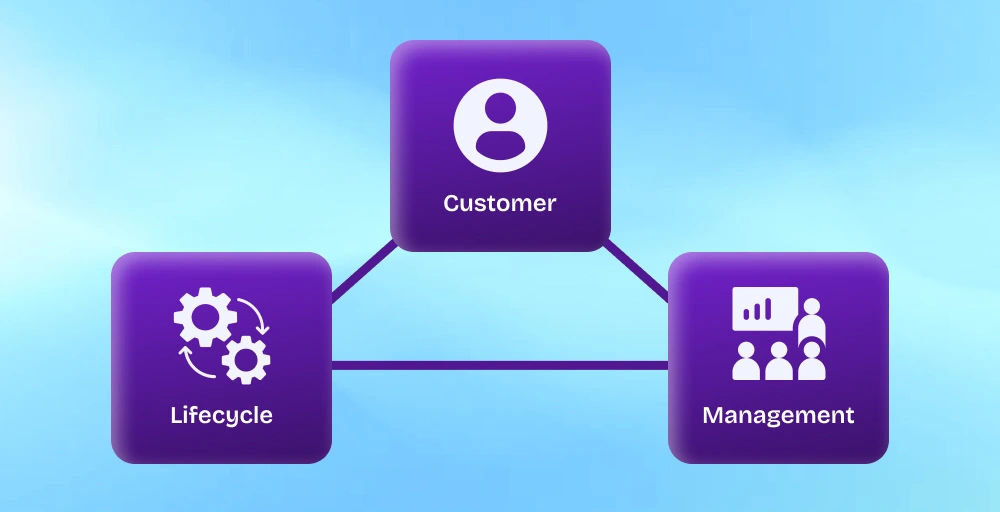
What is customer lifecycle management?
Customer lifecycle management is the proactive strategy of tracking, analyzing, and optimizing every stage of the customer relationship. It involves assigning clear goals and KPIs to each stage, breaking down silos between marketing, sales, support, and success teams, and using data to deliver personalized experiences that drive retention and growth.
What is a customer lifecycle map?
A customer lifecycle map is a visual representation of the stages, touchpoints, emotions, pain points, and opportunities across the entire relationship. It helps teams spot friction, identify high-impact moments, and ensure consistency across channels.
The 5 Customer Lifecycle Stages
The customer lifecycle isn’t a straight line; it’s a dynamic, often non-linear journey where customers can loop back, skip stages, or drop off if experiences fall short. In 2026, successful businesses treat it as an interconnected system powered by data, personalization, and intelligent communication.
Below is a comprehensive breakdown of the five core stages. Each includes clear goals, proven strategies, key metrics to track, common challenges with solutions, and practical tips, including how KrispCall’s AI-driven voice and multi-channel tools can accelerate progress.
Here’s a quick overview table:
| Stage | Description | Primary Goal | Key Metrics |
|---|---|---|---|
| Awareness | Customer discovers your brand | Build visibility | Reach, impressions, brand mentions |
| Engagement | Customer interacts and shows interest | Qualify and nurture | Time on site, content engagement, lead quality |
| Conversion | Customer makes a purchase | Close the sale seamlessly | Conversion rate, sales cycle length, CAC |
| Retention | Post-purchase satisfaction and ongoing value | Reduce churn, drive adoption | Churn rate, NRR, adoption rate, CSAT |
| Loyalty | Customer becomes an advocate | Generate referrals & expansion | Referral rate, NPS, lifetime value |
1. Awareness (Reach)
This is the entry point of the customer lifecycle. Potential customers first discover your brand or solution either because they’re actively searching for answers to a problem or they passively encounter your content through ads, social media, or recommendations.
At this stage, people aren’t ready to buy; they’re simply becoming aware that a solution like yours exists. The focus is on visibility among the right audience without wasting budget on unqualified traffic.
Primary Goals:
Attract qualified prospects cost-effectively, build initial brand recognition, and plant seeds of trust. Aim to appear in the moments when your ideal customer realizes they have a pain point.
Key Strategies:
- High-quality content marketing (blogs, guides, videos, infographics) optimized for search intent.
- SEO to rank for problem-solving keywords.
- Social media thought leadership and organic reach.
- Targeted paid advertising (Google Ads, social platforms).
- PR, influencer partnerships, and guest appearances.
- Educational webinars or free resources that position your brand as an authority.
Metrics to Track:
- Website traffic (unique visitors, page views)
- Impressions and reach
- Share of voice (how often your brand is mentioned vs. competitors)
- Cost per impression or cost per qualified visitor
- Click-through rate (CTR) from ads or content
Common Challenges & Solutions:
Standing out in noisy digital channels is tough due to ad fatigue, and algorithm changes make organic reach harder. Solution: Focus on value-first content that solves real problems rather than hard-selling. Use audience segmentation early to target high-intent users.
2. Engagement (Acquisition/Consideration)
Once aware, prospects move into active interest. They research options, compare solutions, read reviews, and interact with your brand. This stage (sometimes called consideration or acquisition) bridges awareness and purchase.
Primary Goals:
Build trust, qualify leads, nurture interest, and move prospects deeper into the funnel by demonstrating relevance and value.
Key Strategies:
- Personalized content based on behavior (e.g., targeted emails, dynamic website experiences).
- Webinars, demos, case studies, and comparison guides.
- Live chat, chatbots, email nurturing sequences, and multi-channel outreach (SMS, social messaging).
- Account-based marketing (ABM) for high-value prospects.
- Interactive tools like calculators, quizzes, or configurators.
Metrics to Track:
- Engagement rate (time on site, pages per session, content interaction)
- Lead volume and lead quality score
- Time-to-engagement (how quickly prospects respond or interact)
- Email open and click rates
- Behavioral signals (downloads, video views, repeated visits)
Common Challenges & Solutions:
Prospects get overwhelmed by choices and may ghost if interactions feel generic. Solution: Use behavioral data for early segmentation and deliver hyper-relevant follow-ups. AI helps predict what content or channel works best for each person.
3. Conversion
This is the pivotal “moment of truth” when interest transforms into revenue. The prospect decides to buy, sign up, or subscribe.
Friction at this stage (complicated checkout, slow responses, lack of reassurance) kills deals quickly.
Primary Goals:
Remove barriers, provide confidence, and close the sale as smoothly and quickly as possible while maximizing average order/value.
Key Strategies:
- Simplified checkout processes and one-click options where possible.
- Strong trust signals (reviews, security badges, guarantees, social proof).
- Multiple payment methods and flexible pricing.
- Proactive support during decision-making (live assistance, FAQs, comparison tools).
- Urgency or scarcity tactics are used ethically (limited-time offers, stock indicators).
Metrics to Track:
- Conversion rate (visitors to customers)
- Average order/deal value
- Sales cycle length
- Win/loss ratio
- Abandoned cart or form abandonment rate
Common Challenges & Solutions:
Last-minute doubts or delays in getting questions answered. Solution: Offer instant support options and use data to anticipate objections.
4. Retention
Often called the most profitable stage, retention shifts focus from acquisition to delivering ongoing value and preventing churn. A retained customer costs far less to serve and generates recurring revenue.
Primary Goals:
Drive product adoption, ensure satisfaction, encourage repeat business or renewals, and reduce churn.
Key Strategies:
- Structured onboarding programs with clear milestones.
- Proactive support and regular value-check-ins.
- Personalized recommendations and usage tips.
- Feature education, success communities, and feedback loops.
- Omnichannel communication (voice, messaging, in-app) for context-aware support.
Metrics to Track:
- Churn rate (monthly/annual)
- Net Revenue Retention (NRR) ideally over 100% for growth
- Feature adoption and usage rates
- Customer Satisfaction (CSAT) and Net Promoter Score (NPS)
- Renewal rate and expansion revenue
Common Challenges & Solutions:
Silent churn (customers stop using without complaining) and poor onboarding (up to 40-60% of users never fully activate). Solution: Monitor leading indicators like declining usage and intervene early with proactive outreach. AI-powered predictive models flag at-risk customers before they leave.
5. Loyalty (Advocacy)
In the final stage, satisfied customers become enthusiastic promoters who refer others, provide testimonials, and expand their own spend. This creates a virtuous growth loop.
Primary Goals:
Transform customers into brand ambassadors, generate organic referrals, and drive expansion revenue.
Key Strategies:
- Loyalty and rewards programs with meaningful perks.
- Referral incentives (discounts, credits, exclusive access).
- Community building (forums, events, user groups).
- Case study and testimonial opportunities.
- Exclusive content, early access, or VIP events for top advocates.
Metrics to Track:
- Referral rate and referral-attributed revenue
- Review volume and sentiment
- Expansion revenue (upsells, cross-sells)
- Advocacy score or NPS (percentage of promoters)
- Time-to-advocacy (how quickly customers start referring)
Common Challenges & Solutions:
Many happy customers never actively advocate unless prompted. Solution: Make it easy and rewarding with simple referral links, templates, and recognition.
How to manage the customer lifecycle management process?
Managing the customer lifecycle effectively requires a structured, cross-functional approach that aligns teams, technology, and processes around the customer. In 2026, the most successful businesses treat CLM as a continuous, data-driven system rather than isolated campaigns.
Follow these 10 practical steps to create a robust framework that drives higher retention, increased customer lifetime value (CLV), and sustainable growth.
1. Identify your ideal customer profiles (ICPs) and buyer personas.
Start by deeply analyzing your most successful existing customers, those with the highest lifetime value, lowest churn, shortest sales cycles, and strongest advocacy. Gather data from your CRM, sales records, customer success interactions, and support tickets to pinpoint firmographic details (industry, company size, revenue, location, tech stack) and behavioral patterns. Combine this with qualitative insights through interviews or surveys to build detailed buyer personas that capture demographics, pain points, goals, motivations, and decision-making processes.
This foundational step ensures every subsequent effort targets high-potential prospects who are likely to succeed with your solution, reducing wasted marketing spend and improving conversion rates. Regularly revisit and refine your ICPs as market conditions and product offerings evolve, because misalignment here leads to attracting customers who churn quickly.
2. Map the full customer journey with touchpoints and emotions.
Create a visual customer journey map that documents every interaction a customer has with your brand across all stages from initial awareness through loyalty. Include all touchpoints (website visits, ads, emails, calls, support tickets, onboarding sessions) and layer in what the customer thinks, feels, says, and does at each moment. Involve cross-functional teams from marketing, sales, support, and success to capture a complete picture, and validate the map with real customer feedback or analytics data.
This exercise reveals friction points, emotional highs and lows, and opportunities for improvement. In 2026, treat the map as a living document and update it quarterly, as customer behaviors shift rapidly with new technologies and expectations. A well-crafted map prevents siloed experiences and helps teams anticipate needs before problems arise.
3. Set clear, measurable CLM goals aligned with business objectives.
Define specific, quantifiable objectives for each lifecycle stage that directly support broader company goals such as revenue growth, reduced churn, or improved Net Revenue Retention (NRR). For example, set targets like “increase conversion rate by 15% in the next quarter” or “achieve 110% NRR by improving retention metrics.”
Use SMART criteria (Specific, Measurable, Achievable, Relevant, Time-bound) and align them across departments through RevOps collaboration. This alignment ensures everyone works toward the same outcomes and provides clear KPIs to track progress. Without measurable goals, CLM efforts become vague and hard to optimize; with them, you gain the ability to forecast accurately and demonstrate ROI to leadership.
4. Increase brand visibility through targeted channels.
Once you understand your ideal customers, focus on reaching them efficiently through the channels where they actively research solutions. Invest in SEO-optimized content, targeted paid advertising, social media thought leadership, PR, partnerships, and educational resources like webinars or lead magnets.
Prioritize quality over quantity by tailoring messaging to solve specific pain points rather than broadcasting generic promotions. Track performance with metrics such as cost per qualified lead and share of voice. In today’s noisy digital environment, combining organic and paid efforts with precise audience segmentation delivers better ROI and builds early trust, setting the stage for stronger engagement downstream.
5. Personalize every interaction using unified customer data.
Break down data silos by creating a single customer view that aggregates information from CRM, support systems, analytics platforms, and communication tools. Use this unified data to deliver relevant, timely experiences such as dynamic website content, personalized email sequences, or tailored recommendations based on past behavior and preferences.
In 2026, personalization at scale is no longer optional; customers expect it, and businesses that deliver it see significantly higher engagement and loyalty. Start with behavioral segmentation and progress to predictive personalization powered by insights. The result is interactions that feel thoughtful rather than generic, which dramatically improves trust and progression through the lifecycle.
6. Deliver proactive, multi-channel support throughout the journey.
Shift from reactive “wait-and-respond” support to proactive outreach that anticipates needs and resolves issues before customers even complain. Monitor usage patterns, health scores, and leading indicators (such as declining feature adoption) to trigger timely check-ins via email, SMS, in-app messages, or phone calls.
Offer support across multiple channels so customers can engage on their preferred platform without friction. This approach builds stronger relationships, reduces churn risk, and enhances satisfaction. Businesses using proactive multi-channel strategies often report higher retention rates because customers feel genuinely cared for at every stage of their journey.
7. Optimize with AI, automation, and self-service options.
Leverage artificial intelligence and automation to scale personalization, predict churn, route inquiries intelligently, and provide instant self-service resources. In 2026, AI is transforming CLM by enabling real-time sentiment analysis, predictive scoring, and automated workflows that free human teams for high-value interactions.
Implement smart chatbots, automated onboarding sequences, and self-service knowledge bases that genuinely resolve issues. However, balance automation with human empathy, seamless handoffs from AI to live agents are critical. Tools that combine AI with reliable communication channels allow you to deliver faster, more consistent support while reducing operational costs and improving overall customer experience.
8. Streamline conversion and onboarding processes.
Remove every possible point of friction during the critical conversion and onboarding phases. Simplify checkout flows, provide clear trust signals, offer multiple payment options, and ensure prospects can get immediate answers through proactive support.
Once the sale is closed, deliver a structured onboarding program with clear milestones, educational resources, and regular check-ins to drive quick adoption. Many customers decide whether to stay or churn within the first 30–90 days, so a smooth, value-focused onboarding experience sets the tone for long-term success. Regularly test and optimize these processes using data from abandoned carts, support tickets, and feedback surveys.
9. Focus relentlessly on retention and expansion.
Retention is often the most profitable part of the customer lifecycle, as keeping an existing customer costs far less than acquiring a new one. Implement ongoing value delivery through personalized recommendations, feature adoption campaigns, regular business reviews, and proactive support for at-risk accounts.
Monitor key metrics like churn rate, NRR, and CSAT closely, and act on early warning signals. Encourage expansion by identifying upsell or cross-sell opportunities based on usage data and customer goals. In 2026, companies that treat retention as a strategic priority rather than an afterthought achieve sustainable growth even in challenging economic conditions.
10. Encourage advocacy through rewards and recognition.
Turn satisfied customers into active promoters by making advocacy easy and rewarding. Launch referral programs with meaningful incentives, invite top customers to case studies or user communities, and offer exclusive perks such as early access to new features or VIP events.
Recognize advocates publicly (with permission) and make sharing simple with pre-written templates or dedicated referral links. Track advocacy metrics like referral rate and NPS promoter percentage. Happy customers who feel valued are far more likely to provide testimonials, referrals, and expansion revenue, creating a virtuous cycle that lowers acquisition costs and fuels organic growth.
Customer lifecycle management best practices
Implementing customer lifecycle management successfully goes beyond theory; it requires consistent execution of proven best practices.
In 2026, companies that follow these seven core practices see significantly higher retention rates, improved customer lifetime value (CLV), and stronger sustainable growth. Below is a detailed explanation of each best practice.
1. Maintain a single customer view across all departments.
A single customer view (also known as a 360-degree customer profile) brings together all data about a customer’s interactions, purchase history, support tickets, usage behavior, preferences, and feedback into one unified dashboard accessible to marketing, sales, support, and customer success teams.
Without this unified view, departments often work with incomplete or conflicting information, leading to duplicated efforts, inconsistent messaging, and frustrating customer experiences. By centralizing customer data in a well-integrated CRM or CDP, teams can deliver coherent experiences at every stage of the lifecycle. This practice reduces errors, speeds up decision-making, and builds deeper trust because customers no longer have to repeat their story when moving between departments.
2. Segment customers intelligently and personalize at scale.
Intelligent customer segmentation goes far beyond basic demographics. It combines firmographic data, behavioral signals, purchase patterns, engagement levels, and predictive scores to create meaningful customer groups. Once segmented, you can personalize every interaction from email content and website experiences to support responses and product recommendations at scale.
In today’s market, generic experiences no longer compete. Customers expect relevance, and businesses that master personalization at scale typically enjoy 20–30% higher engagement rates and significantly better conversion and retention. The key is to start simple and gradually increase sophistication using automation and AI tools that dynamically adjust messages based on real-time behavior.
3. Track stage-specific KPIs and act on leading indicators.
Instead of relying solely on lagging metrics like churn rate or overall revenue, monitor KPIs that are specific to each stage of the customer lifecycle. For example, track website traffic and impressions in Awareness, engagement rate and lead quality in Engagement, conversion rate in Conversion, Net Revenue Retention (NRR) and feature adoption in Retention, and referral rate in Loyalty.
Equally important is acting on leading indicators, early warning signals, such as declining login frequency, reduced feature usage, or negative sentiment in support interactions, before customers actually churn. This proactive approach allows you to intervene early, prevent revenue loss, and continuously optimize the customer experience. Companies that master stage-specific tracking and leading-indicator response often reduce churn by 15–25%.
4. Integrate AI for predictive insights and automation.
Artificial intelligence has become one of the most powerful tools in modern customer lifecycle management. AI can analyze vast amounts of customer data to predict churn risk, identify upsell opportunities, recommend next-best actions, and automate repetitive tasks. In 2026, leading companies will use AI not just for automation but for genuine predictive intelligence flagging at-risk accounts weeks before churn or suggesting personalized offers based on behavioral patterns.
When integrated thoughtfully, AI frees human teams to focus on high-value, empathetic interactions while improving speed and accuracy across the entire lifecycle. The most successful implementations balance automation with human oversight to maintain warmth and trust.
5. Break down silos with RevOps collaboration.
Revenue Operations (RevOps) brings marketing, sales, customer success, and support teams together under a unified strategy focused on the entire customer lifecycle rather than departmental goals. Silos between teams often cause disjointed experiences, marketing promises one thing, sales deliver another, and support handles issues in isolation.
By adopting a RevOps model, organizations align processes, data, technology, and incentives around the customer journey. This collaboration ensures smooth handoffs between stages, consistent messaging, and shared accountability for customer outcomes. Companies practicing strong RevOps collaboration report faster growth and higher customer satisfaction because everyone works toward the same end-to-end success metrics.
6. Continuously test, measure, and iterate.
Customer expectations, technology, and market conditions evolve rapidly, so customer lifecycle management must be treated as an ongoing optimization process rather than a set-it-and-forget-it strategy. Establish a regular cadence of testing new approaches, whether it’s a different onboarding sequence, a new communication channel, or a revised personalization tactic, then measure the results against your stage-specific KPIs.
Use A/B testing, customer feedback surveys, and analytics to identify what works and what doesn’t. Successful CLM teams review performance monthly or quarterly and quickly iterate based on data. This culture of continuous improvement keeps your strategy fresh, relevant, and increasingly effective over time.
How KrispCall Elevates Your Customer Lifecycle Management
KrispCall’s AI-powered cloud phone system integrates beautifully into every stage:
- Engagement & Conversion: Click-to-call and virtual numbers capture leads faster.
- Retention: Proactive outbound calls, smart routing, and context-aware support reduce frustration.
- Loyalty: Dedicated lines for VIP customers create white-glove experiences.
Businesses using modern communication tools like KrispCall see higher engagement, faster resolutions, and stronger relationships, directly translating to better CLV and lower churn.
Book a Free Demo today to see the difference.