

Most people don’t think about customer support until something goes wrong, and when it does, the last thing anyone wants is to spend ten minutes searching for the right number to call.
A simple three-digit shortcode, 611, built into every mobile network is all it takes to reach carrier support directly, for free, and without needing the internet.
In this guide, we’ll break down everything worth knowing about 611: what it is, what it’s used for, how to use it effectively, and what to do when it doesn’t go as smoothly as expected.
✨ Key Takeaways
- Dialing 611 connects you directly to your mobile provider’s customer service without needing to search for a number or use the internet.
- 611 handles most account-related needs, from billing questions and plan changes to technical troubleshooting and SIM management.
- 611 calls are typically free and automatically linked to your account when dialed from your phone, speeding up verification and assistance.
- Calling from your device, preparing account details, and navigating menus carefully can significantly reduce wait time and improve resolution.
What is 611 phone number?
The 611 phone number provides a direct link between mobile subscribers and their service providers. It is also known as a short code or an N11 code and is used across North America. It serves as a universal shortcut to reach the customer service and technical support departments of a wireless carrier.
It’s worth noting that 611 is not a traditional phone number you can look up in a directory or trace using a 611 phone number lookup tool. It’s a dedicated service code regulated by telecom authorities, designed purely for customer service access, not personal or business calls.
Practical example of using the 611 phone number: John notices an unexpected charge on his mobile bill. Instead of searching online, he simply dials 611 from his phone.
He is instantly connected to his carrier (like Verizon or AT&T), where an automated system lets him check his balance or speak to a representative to resolve the issue.
What is 611 phone number used for?
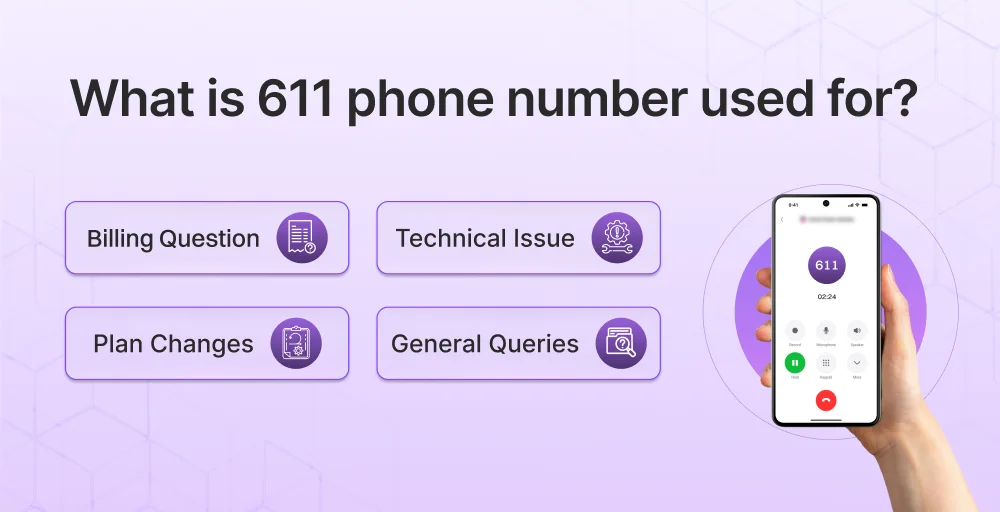
Here are the primary ways this 611 service code is utilized:
1. Account and billing inquiries
Users frequently call 611 to check their current balance, review recent charges, or make a payment. It provides an automated or live-agent path to resolve billing issues without needing to log in to a web portal.
2. Technical support and troubleshooting
Experiencing dropped calls, slow data speeds, or trouble connecting to the network? Dialing 611 connects you to technical support agents who can run diagnostics and walk you through troubleshooting steps.
3. Plan upgrades and modifications
The 611 customer service phone number gives you direct access to account specialists. It makes it easy for subscribers to change their current service tier, add international roaming packages, or increase data limits.
4. Device activation and SIM management
New devices can often be registered or activated by dialing 611. It is also the designated line for reporting a lost or stolen phone, allowing the carrier to immediately suspend the line to prevent unauthorized usage.
5. Carrier-specific information
For those specifically wondering what is 611 phone number Verizon or AT&T provides, it often includes access to localized promotions, corporate store locations, and automated updates on local network outages.
6. General customer service
Beyond technical and financial needs, 611 acts as a general 611 customer service phone number for inquiries regarding warranty claims, insurance enrollment, and broad policy questions.
How to use the 611 number effectively?
To get the most out of the 611 phone number, it is important to understand the best practices for navigating the carrier’s automated systems:
- Call from the device in question: Whenever possible, call 611 directly from the handset experiencing the issue.
- Have your information ready: Keep key details on hand, like account number, billing address, the last four digits of your SSN, or any recent transaction references.
- Be clear and specific: Take a moment to clearly define the issue with specific details. The more specific the information provided, the faster the resolution.
- Use the automated menu strategically: Most carriers route calls to 611 through an automated system first. So, listen carefully and select the one that most closely matches the issue.
- Take notes during the call: It’s easy to forget what was discussed once the call ends. Jotting down the agent’s name, the case or ticket number, and any promises made during the call creates a clear record.
- Follow up if the issue isn’t resolved: Not every issue gets resolved in a single call. If the problem persists, calling back and referencing the previous ticket number moves things along much faster.
What are the common problems when using 611?
While the 611 phone number is designed to make customer support more accessible, the experience isn’t always seamless. Understanding these common issues can help in navigating the system more effectively:
1. Long wait times and hold queues
During peak hours or high-traffic periods, the 611 line can be difficult to reach, leaving users stuck in an endless redial loop.
Solution: Unfortunately, this is a carrier-side limitation, and there’s no real workaround other than calling during off-peak hours or requesting a callback if the carrier offers one.
2. Getting stuck in automated menus
The IVR system is built around common scenarios, but real problems don’t always fit neatly into preset menu options. Users are often left cycling through choices that don’t quite match their issue
Solution: Select the closest available option and explain the actual situation directly to the live agent once connected. Trying to force-fit the problem into the wrong menu only delays reaching someone who can actually help.
3. Poor call quality mid-conversation
A weak signal during a support call can cut off an agent mid-explanation or drop the call entirely, forcing the whole process to restart from scratch.
Solution: Switch to Wi-Fi calling before dialing the 611 customer service phone number. If that’s not an option, moving to an area with better reception can improve call stability enough to get through the conversation cleanly.
4. Forgetting verification details
Carriers require identity verification before making any account changes, and being unable to provide the correct PIN or details can bring the entire call to a halt, even if the issue is urgent.
Solution: Store account credentials securely in a password manager so they’re always accessible when needed. Keeping everything ready before dialing 611 keeps the verification step quick and painless.
5. Unresolved technical issue
Sometimes a fix is promised during the call, but doesn’t hold, or the problem resurfaces within hours, sending users right back to square one.
Solution: Start with the basics. Restart the device and check network settings before assuming it’s a carrier-side failure. If the problem persists, call 611 again and reference the previous ticket number.
611 vs other customer support numbers: what’s the difference?
When deciding how to contact a service provider, understanding the distinction between shortcodes and traditional lines is key for efficiency. Here are the primary differences between 611 and other support numbers:
- Network routing: The phone number 611 automatically routes the call to the carrier providing the signal, whereas a standard number requires manual dialing and routing through the general public switched telephone network.
- Cost and accessibility: For most North American carriers, including Verizon and AT&T, dialing 611 is free. In contrast, calling a non-toll-free support line from a mobile device may incur airtime charges, depending on the user’s plan.
- Automatic account identification: When a user chooses to call 611 phone number from their own device, the carrier’s system receives the caller ID and SIM information instantly. A standard support number called from a different phone requires a manual number lookup or a full account verification.
- Universal standards: The 611 shortcut is a North American standard (N-1-1). While a carrier might change its 1-800 support numbers during a merger or rebranding, the 611 code remains a constant, reliable point of entry for the consumer.
What are alternatives to 611 phone numbers?
While dialing 611 is a convenient shortcut, it is far from the only way to manage a wireless account or seek technical support. Depending on the situation, some of these alternatives can be just as effective and in certain cases, even faster.
- Carrier-specific toll-free number: Every major service provider maintains standard 10-digit toll-free lines (e.g., 1-800-VERIZON or 1-800-TMOBILE) as an alternative to the 611 phone number.
- Official mobile applications: Most modern carriers encourage the use of their proprietary apps for account management. These platforms allow users to bypass the 611 customer service phone number entirely for a wide range of support needs.
- Live chat on the carrier’s website: For users who prefer typing to talking, live chat support on the carrier’s official website is a strong alternative to calling the 611 customer service number.
- Social media support channels: Many providers have dedicated support teams on platforms such as X (formerly Twitter) and Facebook. These teams are often highly responsive and empowered to resolve complex issues publicly or via direct message.
- Physical retail locations: For issues requiring physical verification or hardware inspection, visiting a carrier’s storefront remains a primary option. This is often the required path if a 611 phone number lookup fails due to forgotten security credentials.
Conclusion
The 611 phone number stands as a highly efficient and accessible gateway to mobile carrier support. It provides a streamlined path for resolving service inquiries, network glitches, or hardware issues without needing to track down specific corporate contact details.
Since most providers offer this as a complimentary service, it remains a cost-effective solution for immediate assistance.
By leveraging this pre-programmed shortcut, subscribers can bypass traditional search methods and connect with a 611 customer service representative or an automated system in seconds, ensuring their mobile experience remains uninterrupted.