

Customers have more ways than ever to connect with businesses, including email, live chat, social media, and messaging apps. Still, communication via a business phone number remains one of the most trusted and highest-converting channels, especially for sales, support, and urgent inquiries.
Choosing between a toll-free or local number directly impacts customer trust, brand perception, and business growth.
Should your business use a local phone number, create a strategy, or invest in a toll-free phone number?
The debate around local vs toll-free numbers isn’t just about costs. It affects:
- Customer trust and credibility
- Call volume and lead quality
- Marketing performance
- Scalability as your business grows
This guide breaks down the toll-free vs local number decision in a clear, practical way and helps you choose the best one.
✨ Key Takeaways
- 82% of consumers are more likely to answer calls from local area codes than toll-free numbers, making them ideal for cold outreach and regional campaigns.
- Toll-free numbers, particularly vanity numbers, create a professional, nationwide image and help businesses project authority and trustworthiness.
- Local numbers are more cost-effective, while toll-free numbers may incur higher costs due to per-minute charges for incoming calls.
- Toll-free numbers offer greater scalability, allowing businesses to expand nationally without geographical limitations.
- Businesses can leverage local numbers for regional marketing and toll-free numbers for national support, maximizing reach and customer experience.
Toll-free vs. local number: Which one should your business use?
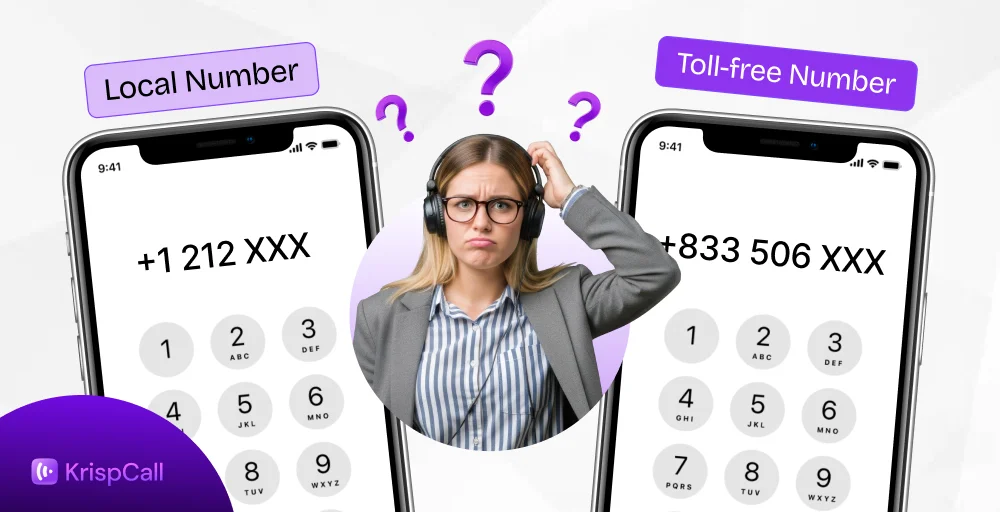
Toll-free and local numbers are commonly used business phone numbers that allow customers to contact companies easily.
For a national presence, toll-free numbers are ideal. Toll-free numbers offer nationwide accessibility, enhance a company’s credibility, and support businesses with a broad customer base across multiple regions. They are especially effective for software companies, SaaS platforms, and brands focused on inbound calls.
Local numbers, on the other hand, help businesses dominate the local market, build trust in specific markets, and create familiarity tied to a specific location.
What is a local phone number?
A local phone number is associated with a specific location or geographic area and includes an area code tied to a city or region. This makes it ideal for businesses targeting specific markets or local customers.
Creating a local phone number helps customers feel they are calling someone nearby, reinforcing trust and approachability.
Local phone number providers typically do not charge for incoming calls, making them cost-effective and suitable for small teams that want to avoid incurring charges for inbound traffic.
What is a toll-free number?
A toll-free number allows customers to call a business without paying any fees. The business absorbs the cost, removes communication barriers, and provides better customer satisfaction.
These numbers use a three-digit prefix, such as 800, 833, 844, 866, 877, or 888, and are not tied to a city. This makes toll-free numbers ideal for businesses seeking nationwide or international accessibility.
Many businesses use toll-free numbers to project authority, professionalism, and scale, especially established businesses serving customers nationwide.
Local vs Toll-free: Key differences
Toll-free numbers project a professional, credible image, helping your business feel established and ready to grow on a larger scale.
Let’s look out for the key differences between local and toll-free numbers.
| Aspect | Local number | Toll-free number |
| Number type | Geographics (city or regional area code) | Non-geographics (800, 888, 877, etc.) |
| Primary audience | Local or regional customers | Nationwide or international customers |
| Caller cost | Local or long-distance charges may apply | Free for callers |
| Business cost | Typically lower | Business pays for incoming calls |
| Customer support | Personalized, local service | 24/7 scalable support, high-volume |
| International access | Limited | International toll-free options available |
| Use cases | Small businesses, local offices | Enterprises, call centers, sales campaigns |
| SMS capability | Supported (may vary by region) | Widely supported by providers |
| Trust & familiarlity | High trust among local customers | High credibility for large or growing brands |
| Marketing reach | Local advertising and campaigns | National and multichannel marketing |
Do Local or toll-Free numbers increase answer rates and customer trust?
Yes, but in different ways:
Local number increases answer rate
Studies on call behavior show that people are more likely to answer calls from familiar or local area codes. Many consumers ignore 800 numbers because they associate them with spam or telemarketing.
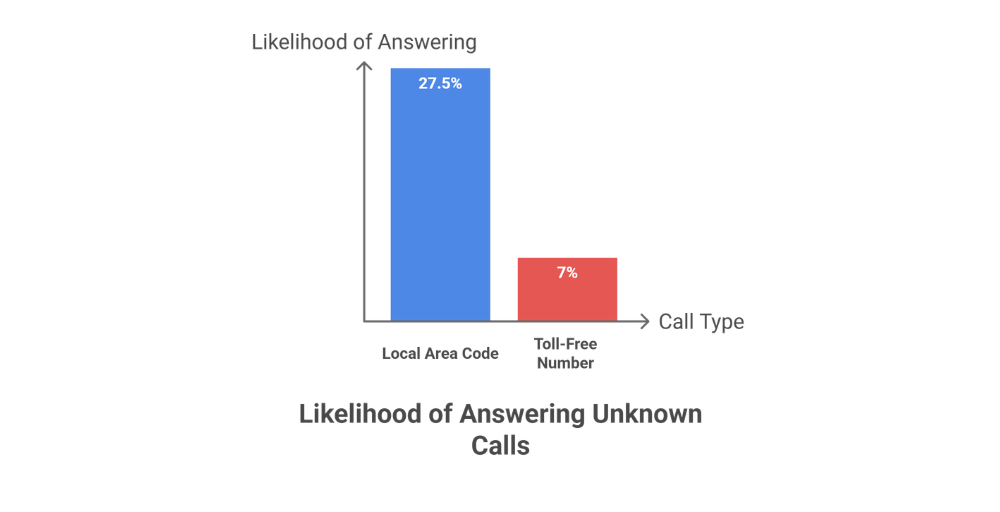
According to a Software Advice Survey, consumers are up to 4 times more likely to answer a local call compared to a generic toll-free number.
- 27.5% are likely to answer an unknown call from a local area code.
- Only 7% of people said they would answer a call from an unknown toll-free number.
Local area codes signal proximity and familiarity, making customers feel more comfortable answering the phone. This leads to higher answer rates, particularly in cold outreach or local sales campaigns.
Toll-Free numbers increase perceived professionalism
Toll-free numbers help create a more professional and credible brand image. While local numbers may increase answer rates, toll-free numbers are often associated with established, nationwide businesses.
Research shows that toll-free vanity numbers, such as memorable word-based formats, are easier to recall than random numeric phone numbers, which strengthens brand recognition.
Customers also feel more confident calling toll-free numbers because they eliminate concerns about long-distance charges. As a result, toll-free numbers reduce hesitation when reaching out for support or sales and improve overall trust when contacting national brands.
So, which builds more trust?
Which number builds more trust depends on your goal. Local numbers work better for local businesses and outbound sales because people are more likely to answer and feel connected.
Toll-free numbers build more credibility for national brands and make inbound support feel easier and more professional. That’s why many businesses use both, local for outbound calls and toll-free for customer support.
What are the technical differences between local and toll-Free numbers?
From a technology standpoint, both number types work on modern cloud phone systems, but they differ in cost structure, routing flexibility, and scalability.
Call routing & ivr: Both local and toll-free numbers can use ivr menu, call forwarding, call recording, and CRM integrations. However Toll-free numbers are commonly used as a central routing hub for high-volume support teams, and Local numbers are often used for region-specific routing, like directing New York calls to a NYC team.
Geographic flexibility: Local numbers are tied to an area code, whereas Toll-free numbers are not location-based. A toll-free number can stay the same even if your company moves offices, but multiple local numbers may be needed if you expand into new cities.
Portability & scalability: Both number types can be ported between providers, but toll-free numbers are generally easier to move because they are not tied to a physical exchange. For growing businesses:
- Toll-free numbers scale better for national expansion.
- Local numbers scale better for multi-city presence strategies.
Spam & filtering differences: Toll-free numbers are more frequently targeted by robocalls and spam bots. Because businesses pay for inbound toll-free minutes, spam can increase costs. Local numbers may have slightly better call pickup rates in outbound campaigns.
Pricing & cost breakdown (What businesses actually pay)
To know the pricing for local and toll-free numbers, you need to look beyond the advertised monthly fee. Let’s break down the real expenses that you might have to encounter in the future:
Local number pricing range (monthly + usage)
Local numbers are generally the most cost-effective because they rarely incur per-minute charges for incoming calls within the US and Canada.
- Monthly base cost: $10–$30 per user. Most providers (like Quo or RingCentral) include one local number for free with your subscription.
- Additional numbers: If you need a second local number (e.g., one for Chicago and one for LA), expect to pay an extra $5 per month per number.
- Usage charges: Most modern plans include unlimited inbound calls to local numbers.
- Total monthly estimate: $15–$35 for a standard small-business setup.
Toll-free number pricing range (monthly + per-minute inbound charges)
Toll-free numbers are more expensive because the business owner is paying for the caller’s convenience.
- Monthly base cost: $10–$20 per month (often slightly higher than local numbers if purchased as a standalone).
- Inbound minute charges: the “hidden” variable. Many providers offer a small bundle (e.g., 100–500 minutes) for free, but after that, you pay $0.02–$0.06 per minute.
- Vanity premiums: If you want a specific “word” number (like 1-800-REPAIR), some providers charge a one-time activation fee or a higher monthly “premium” rate.
- Total monthly estimate: $20–$100+, depending entirely on how many times your customers call you.
Hidden costs (spam calls, call recording, call routing, extra seats)
Beyond the number itself, several factors can quietly double your monthly expenses:
- Spam call: Since you pay for every minute on a toll-free line, spam calls actually cost you money. If a robocaller stays on the line for 2 minutes, you’ve just paid ~$0.10 for a junk call.
- Call recording & AI transcription: Basic plans usually only include live calling. If you want to record calls for training or have AI summarize your meetings, providers often charge an extra $5–$15 per user.
- Additional seats: Most modern systems are priced per person. Even if you only have one phone number, if you want three employees to answer it simultaneously on their own apps, you have to pay for three separate “seats” or “users.”
- Taxes & regulatory fees: Don’t forget the “E911” fees and federal universal service fund charges. These can add 10%–20% to your total bill, which is rarely shown in the advertised price.
Pros & cons of local numbers for small businesses
Local numbers offer small businesses with increased local trust, lower costs, higher answer rates, and foster a community feel.
Pros
- Strong local trust: Customers often prefer supporting businesses in their own region, which creates local presence. An area code like 212 for New York or 312 for Chicago immediately signals that you are part of their local community.
- Low operating costs: Local numbers are generally the most affordable option. Most providers include one or more local lines in their basic monthly subscriptions, with no high setup fees.
- Higher answer rates: There is a high chance that people will pick up the call from a familiar area code. For example: “If you’re a local plumber in Chicago with a 312 area code, customers in Chicago are more likely to pick up the phone.”
- Best for service-based businesses: If you are a plumber, lawyer, or florist, a local number reinforces that you can reach customers quickly for house call or local deliveries.
- Strengthening local brand identity: Low-cost tools for improving your local brand identity. It transforms your business from a faceless entity into a visible, accessible member of the community.
Cons
- Limited presence: A local number ties you to one specific region. Suppose you have a 415 San Francisco number, but try to sell to someone in Miami, they may assume you aren’t available to help them in their time zone or region.
- Caller pays for the call: While most modern mobile plans include unlimited long-distance, some landline users or specific international callers may still be charged for calling a local number that isn’t in their immediate area.
- Less scalable: If your business grows and you open offices in different states, managing multiple local numbers can become more complex than having a single central toll-free line.
- Not ideal for national campaigns: If you are running a national TV or social media ad, a local number can look “too small”. It suggests you only serve a specific neighborhood rather than the whole country.
- Perceived as small-scale: For some industries like software or national consulting, a local number might make you look like a “a one person-shop”, rather than an established professional corporation.
Pros & cons of toll-free numbers for small businesses
Toll-free numbers are designed to remove barriers and project a “big business” image regardless of your actual size. It helps small businesses bridge the gap between being a local startup and becoming a recognized national brand.
Pros
- Free for customers: A toll-free number removes the cost of the call, showing customers you value their time and business and encouraging them to reach out for sales or support.
- Nationwide reach: A toll-free number isn’t tied to a location. This allows you to market your products from coast to coast without appearing “out of town” to customers three states away.
- Professional brand image: There is a psychological association between toll-free numbers and established corporations. Using one can make a “solopreneur” or small team appear as a credible, large-scale operation.
- Perfect for sales and support teams: These numbers are designed for high-volume routing. You can easily set up an automated menu (IVR) to direct callers to “Sales”, “Billing”, or “Support”, creating a seamless professional experience.
- Easier to port to new carriers: Toll-free numbers are easy to move between service providers because they are not tied to a local exchange or physical switchboard. This makes it simpler to transfer the number as a business grows, often speeding up the process.
Cons
- Higher costs to business: Unlike local calls, where the caller usually pays, toll-free owners pay for every minute of incoming call time. If you have a high call volume, these monthly usage fees can add up quickly.
- Less personalized calls: Because the number is generic, it lacks the “neighborly” warmth of a local area code. Some customers may be calling a massive call center rather than a dedicated local partner.
- Hidden Fees: Beyond the per-minute rate, many providers charge extra for features like call recording, international routing, or vanity “word” numbers (like 1-800-BUY-NOW).
- Higher spam call volume: Toll-free numbers are frequently targeted by “robocalls” and automated spam bots. Since you pay for incoming minutes, you could pay for the time spent on these junk calls.
- Not always necessary for startups: If your business is in the early stages and your clients are all local, the extra expense and “corporate” feel of a toll-free number might actually create a disconnect with your community.
Best real-life use cases (When to choose what)
Choosing the correct number is a strategic decision that aligns your business strategy and business phone system with your goals. While many businesses eventually use both, your choice should be guided by your primary target audience.
Choose a local number if:
- You offer “on-site” services: If you’re a plumber, real estate agent, or contractor, customers need to know you’re close by. A local phone number create with a recognizable area code shows that you can reach them quickly.
- You rely on location-based search visibility: Search engines rely on consistent business details, like a local phone number, to confirm your physical presence. This helps enhance geographic relevance and strengthens trust signals, ultimately boosting local search visibility and customer discovery.
- You are doing outbound “cold” outreach: When your sales team calls potential customers, they are more likely to answer a local number than an 800 number, which is often flagged as “Potential Spam.”
- You want to create a “Main Street” brand: If your brand is friendly and neighborhood-focused, a local number helps reinforce that connection.
- You are targeting a key city: Even if you’re not based there, using a local number for a city like San Francisco or New York can give you instant credibility in that market.
Choose a toll-free number if:
- You sell products online: If you ship products nationwide, a toll-free number tells customers in any state that you are a national brand equipped to handle their orders.
- You offer specialized technical support: If you provide software or consulting services where the physical location doesn’t matter, a toll-free number creates a professional, centralized “hub” for inbound callers.
- You are running national advertising: For TV, radio, or podcast ads reaching a broad reach, a toll-free number (especially a vanity number like 1-800-CONTACTS) is much easier to remember than a random local code.
- You want to project “Big Company” authority: Startups often use toll-free numbers to appear more established, enhancing customers’ perception of credibility.
- You need international numbers: Toll-free lines can also include a three-digit prefix for global accessibility, helping businesses reach an international audience.
Why using both local and toll-free numbers is effective?
Most of the businesses use both local and toll-free numbers simultaneously. By using both numbers, businesses can significantly improve their business. By strategically deploying both number types, you can maximize the benefits of each while minimizing their respective weaknesses.
Use local numbers in geo-targeted digital ads, local SEO listings, and community partnerships. Use toll-free numbers in national advertising, social media profiles, and email campaigns. This ensures each audience sees the most compelling number for their context.
Local number vs. toll-free for marketing
For marketing, both local and toll-free numbers play an essential role, but in different ways. A local number is used for outbound sales calls to boost answer rates, as recipients are more likely to answer familiar or local area codes. Toll-free numbers encourage inbound customer inquiries by removing call charges, increasing accessibility, and building trust.
Combining both strategies optimizes reach: toll-free for broad, customer-initiated engagement and local numbers for targeted outreach. This dual approach enhances response rates and supports a more personalized customer experience.
Local number for marketing:
- Campaigns using local numbers can boost conversions by 15%–30%, as people are more likely to return calls from local area codes, viewing them as more personal.
- Marketing teams can assign specific local numbers to different cities for A/B testing of regional messaging, helping to identify which neighborhoods respond best to ads.
Toll-free number for marketing:
- Toll-free numbers (like 1-800-CONTACTS) achieve a 110% improvement in consumer recall compared to standard numeric numbers, making them a valuable marketing asset.
- These numbers convey that a business is a nationwide authority and remove geographic bias, indicating the company can support customers anywhere.
Local vs toll-free for contact centers & support teams
For contact centers and support teams, the choice between local and toll-free numbers is a trade-off between high-touch community trust and low-friction national scale. Local numbers increase answer rates due to familiarity and trust, making them better suited for outbound sales or regional outreach.
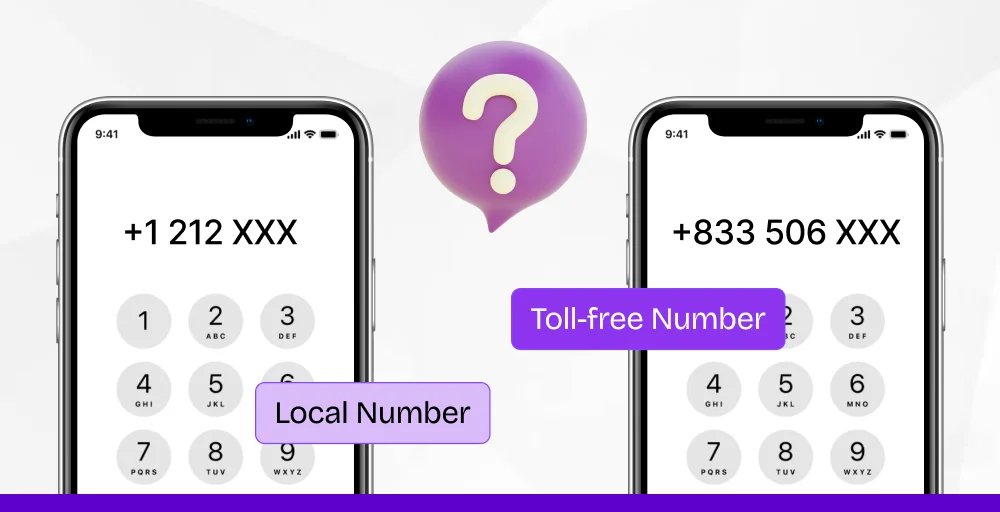
Toll-free numbers, on the other hand, enhance accessibility and brand perception, encouraging customers to call at no cost, thereby improving engagement. They are ideal for inbound support, marketing campaigns, and national outreach. Using both strategically, toll-free for incoming support and local for outgoing calls, optimizes customer experience and operational efficiency.
Reason to choose a local number for contact centers & support teams:
- Local numbers achieve significantly higher response rates for outreach efforts, as customers are more likely to answer familiar area codes than generic 800 numbers.
- Local numbers foster “proximity trust,” making interactions feel more personal and context-aware, enhancing the overall customer experience.
Reasons to choose a toll-free number for contact centers & support teams:
- Toll-free numbers eliminate long-distance charges, encouraging customers to reach out for help, thereby reducing cart abandonment and boosting satisfaction.
- A toll-free number serves as a single entry point, allowing support teams to route calls to various departments or agents without customers needing to dial different numbers.
Conclusion
Choosing between a toll-free number and a local number depends on your business goals and audience. A local number fosters community trust, enhances approachability, and boosts local business, making it ideal for businesses focused on regional engagement. In contrast, a toll-free number is better for scalability and national reach, as it eliminates customer cost barriers and supports high-volume operations.
Many businesses benefit from using both. Local numbers are effective for geo-targeted marketing and outbound sales, while toll-free numbers excel in nationwide advertising and inbound support.
Cloud phone systems make it easy to switch or scale phone options as your business evolves, ensuring that your choice supports customer trust and accessibility. Choose the option that aligns with your audience, budget, and growth vision.